CRACK NEET.
CLAIM YOUR
WHITE COAT.
Transform your medical and engineering career aspirations into reality with Pearls Academy — Tamil Nadu's premier entrance preparation institute. Expert medical faculty, NCERT-grounded curriculum, AIIMS & JEE-level test series, and dedicated mentoring.
Reserve Your Seat
Expert NEET Counseling & Strategy Session




It starts in the classroom
Line-by-line NCERT coverage of Biology, Physics and Chemistry, one daily topic at a time.
Every day, a little sharper
Chapter tests, timed mock exams on the real NTA interface, and doubt clearance with faculty.
Walk in ready
Full-syllabus mocks and revision cycles, so NEET day feels like one more test.
Then, the white coat
Our students have secured MBBS and BDS seats at AIIMS New Delhi, Madras Medical College and government medical colleges across Tamil Nadu.
Book Free CounselingCoaching Aimed at 700+ NEET Scores
Our coaching combines rigorous NCERT coverage, AI-powered performance diagnostics, and expert medical mentorship.
100% NCERT Mastery
Line-by-line dissection of Biology, Organic Chemistry mechanisms, and high-weightage Physics numericals.
AIIMS-Standard Mock Engine
Timed simulations matching exact NTA interface with All India Rank (AIR) predictions and negative mark analysis.
Doctor & Ranker Mentorship
Personalized 1-on-1 strategy sessions, exam temperament coaching, and instant doubt clearance by top educators.
17,562+ Question Bank
Topic-wise practice sets, Assertion-Reason drill modules, and 15+ years of solved NEET/AIPMT questions.
NEET & JEE Programs Designed for Victory.
NEET UG 2027 Complete Medical Entrance Program
Comprehensive 1-year flagship program for NEET UG 2027. Features complete curriculum coverage across Physics, Chemistry, and Biology, dynamic adaptive testing, interactive doubts, and personalized AI weakness analytics.
NEET UG 2027 Target Batch
Structured academic calendar with regular lectures, chapter-wise testing, revision schedules, AI weakness diagnosis, and full-length simulated grand mocks.
NEET UG 2027 Repeater & Dropper Program
Intensive dropper curriculum focused on core concept rebuilding, advanced problem sets, historical PYQ deconstructions, error correction, and multiple systematic revision cycles.
NEET UG 2027 Intensive Crash Course
Rapid 120-day revision course covering high-yield formulas, key diagrams, NCERT line-by-line PYQs, timed chapter drills, and full-syllabus mocks.
NEET UG 2027 Complete Test Series
All-India Grand Test Series with chapter tests, unit tests, part-syllabus tests, grand mocks, detailed video solutions, topic weakness radar, and remedial practice.
JEE Main + Advanced 2027 Complete Engineering Program
Flagship 1-year engineering foundation program covering Physics, Chemistry, and Mathematics from fundamentals up to JEE Advanced multi-correct and numerical depth.
JEE Main + Advanced 2027 Target Batch
Rigorous syllabus coverage with regular problem-solving sessions, chapter-level CBT simulations, advanced problem sets, and personalized analytics.
JEE Main + Advanced 2027 Repeater Program
Intensive problem-solving and concept reconstruction program focused on difficult analytical questions, PYQs, speed accuracy, and systematic test cycles.
JEE Main 2027 Intensive Crash Course
120-day high-yield program covering essential mathematics tricks, reaction mechanisms, physics formula mastery, and timed NTA-pattern mock tests.
JEE Main + Advanced 2027 Test Series
CBT test series with chapter tests, part tests, full JEE Main simulations, JEE Advanced paper 1 & 2 mocks, detailed step solutions, and AI topic weakness radar.
STEM & Olympiad Foundation Program (Classes 6–9)
Comprehensive foundation coaching building strong problem-solving skills in Mathematics, Science, and Mental Ability for Classes 6, 7, 8, and 9.
Curriculum & Syllabus Hierarchy
Follows the official 15-page NMC UGMEB NEET (UG) 2026 syllabus: 50 core units, broken down from textbook basics to daily lecture topics and micro-concept MCQ drills.
Physics, Chemistry, Biology (Botany & Zoology)
Units 1–20 Physics, Units 1–20 Chemistry, Units 1–10 Biology
160+ Core Classroom Lecture & Diagnostic Modules
Least Count, Fajan's Rules, 5 Angiosperm Families, Frog Anatomy
Unit 1: Physics and Measurement
Units of measurements, System of Units, SI Units, fundamental and derived units, least count, significant figures, Errors in measurements, Dimensions of Physics quantities, dimensional analysis, and its applications.
SI System, Fundamental & Derived Units
Base SI physical quantities, definitions, derived units, and prefixes in physics.
Fundamental quantities (mass, length, time, electric current, temperature, amount of substance, luminous intensity) that cannot be expressed in terms of other quantities.
Units formed by algebraic combinations of the base units (e.g. Newton, Joule, Watt, Pascal).
Radian (plane angle) and Steradian (solid angle) as supplementary SI units.
Errors in Measurement & Significant Figures
Systematic and random errors, absolute, relative, and percentage errors, rules for significant figures.
Magnitude of the difference between the individual measurement and the true value (mean value) of the quantity.
Ratio of the mean absolute error to the mean value of the measured quantity.
All certain digits in a measurement plus the first doubtful/uncertain digit.
Least Count & Precision Measuring Instruments
Principles and least count of Vernier calipers and micrometer screw gauge, zero error corrections.
Smallest value that can be measured directly by an instrument.
Difference between one main scale division (1 MSD) and one vernier scale division (1 VSD).
Linear distance moved by the spindle per one complete rotation of the circular head.
Dimensional Analysis & Its Applications
Dimensions of physical quantities, dimensional formulas, principle of homogeneity, and derivations.
Expression showing which powers of fundamental quantities enter into the unit of a physical quantity.
Every term on both sides of a physically valid equation must possess the exact same dimensions.
Unit 2: Kinematics
Frame of reference, motion in a straight line, Position-time graph, speed and velocity; Uniform and non-uniform motion, average speed and instantaneous velocity, uniformly accelerated motion, velocity-time, position-time graph, relations for uniformly accelerated motion, Scalars and Vectors, Vector addition and subtraction, scalar and vector products, Unit Vector, Resolution of a Vector. Relative Velocity, Motion in a plane, Projectile Motion, Uniform Circular Motion.
Rectilinear Motion & Graph Kinematics
Position-time, velocity-time, and acceleration-time graphs, average vs instantaneous velocity.
Rate of change of position at a specific instant of time: v = dx/dt.
Represents the instantaneous acceleration of the particle.
Represents the total displacement of the particle over the time interval.
Uniformly Accelerated Motion & Free Fall
Kinematic equations for constant acceleration, vertical motion under gravity, stopping distance.
Motion of an object influenced solely by gravitational acceleration g (9.8 m/s^2).
Distance traveled by a vehicle before stopping: s = u^2 / (2a).
Vectors, Resolution & Relative Velocity
Vector algebra, dot product, cross product, unit vectors, relative velocity in 1D and 2D.
Vector of unit magnitude in a specified direction: \hat{A} = \vec{A}/|A|.
\vec{A}\cdot\vec{B} = |A||B|\cos\theta, maximum when vectors are parallel.
\vec{A}\times\vec{B} = |A||B|\sin\theta\,\hat{n}, perpendicular to both vectors.
Projectile Motion & Uniform Circular Motion
2D oblique projectile trajectories, time of flight, horizontal range, maximum height, centripetal acceleration.
Parabolic path of an oblique projectile in absence of air resistance.
Inward radial acceleration maintaining uniform circular path: a_c = v^2/r = \omega^2 r.
Unit 3: Laws of Motion
Force and inertia, Newton's First law of motion; Momentum, Newton's Second Law of motion, Impulses; Newton's Third Law of motion. Law of conservation of linear momentum and its applications. Equilibrium of concurrent forces. Static and Kinetic friction, laws of friction, rolling friction. Dynamics of uniform circular motion: centripetal force and its applications: vehicle on a level circular road, vehicle on a banked road.
Newton's Laws & Momentum Conservation
Inertia, momentum, impulse, action-reaction pairs, recoil of gun, rocket propulsion.
Product of average force and time duration, equal to change in linear momentum: J = \Delta p.
Total linear momentum of an isolated system remains constant when net external force is zero.
Friction (Static, Kinetic & Rolling)
Microscopic origin, laws of friction, coefficient of friction, angle of friction and repose.
Maximum value of static friction that comes into play just before body begins to slide.
Minimum angle of inclination of an inclined plane at which a body placed on it begins to slide down: tan(theta) = mu_s.
Circular Dynamics & Road Banking
Centripetal force, safe speed on flat circular road, optimal banking angle, friction-assisted banking.
Net real inward radial force causing circular path: F_c = mv^2/r.
Angle theta such that horizontal component of normal force supplies full centripetal force: tan(theta) = v^2/(rg).
Unit 4: Work, Energy, and Power
Work done by a constant force and a variable force; kinetic and potential energies, work-energy theorem, power. The potential energy of spring conservation of mechanical energy, conservative and non-conservative forces; motion in a vertical circle: Elastic and inelastic collisions in one and two dimensions.
Work Done & Work-Energy Theorem
Scalar product definition of work, work by spring/variable forces, work-energy theorem.
W = \int F(x) dx, equal to area under force-displacement curve.
Work done by all forces equals change in kinetic energy.
Potential Energy & Vertical Circular Motion
Conservative forces, spring potential energy, conservation of mechanical energy, loop-the-loop vertical circle.
Force whose work is independent of path and zero around closed loop (F = -dU/dx).
Minimum speed at top (sqrt(gr)) and bottom (sqrt(5gr)) to complete loop without string slackening.
Collisions in 1D and 2D
Elastic vs inelastic collisions, coefficient of restitution, oblique collisions, kinetic energy loss.
Ratio of relative speed of separation to relative speed of approach: e = (v2 - v1)/(u1 - u2).
Collision where bodies stick together (e = 0) with maximum loss of kinetic energy.
Unit 5: Rotational Motion
Centre of mass of a two-particle system, Centre of mass of a rigid body; Basic concepts of rotational motion; moment of a force; torque, angular momentum, conservation of angular momentum and its applications; The moment of inertia, the radius of gyration, values of moments of inertia for simple geometrical objects, parallel and perpendicular axes theorems and their applications. Rigid body rotation and equations of rotational motion, comparison of linear and rotational motions.
Centre of Mass & Multi-Particle Systems
Centre of mass coordinates, velocity and acceleration of CM, continuous mass distributions.
Point at which the entire mass of a body or system of particles is assumed to be concentrated.
Internal forces cancel in pairs according to Newton's 3rd law and cannot alter the acceleration of the CM.
Torque & Angular Momentum Conservation
Torque, cross product definition, angular momentum of particle and rigid body, conservation of angular momentum.
Rotational analogue of force: \vec{\tau} = \vec{r}\times\vec{F} = I\vec{\alpha}.
When net external torque on a system is zero, total angular momentum L = I omega remains constant.
Moment of Inertia & Rotational Dynamics
Radius of gyration, parallel and perpendicular axis theorems, MOI of ring, disc, cylinder, sphere.
Effective radial distance from rotational axis where total mass could be concentrated: I = Mk^2.
I = I_cm + Md^2, where d is perpendicular distance to parallel centroidal axis.
Unit 6: Gravitation
The universal law of gravitation. Acceleration due to gravity and its variation with altitude and depth. Kepler's law of planetary motion. Gravitational potential energy; gravitational potential. Escape velocity, Motion of a satellite, orbital velocity, time period and energy of satellite.
Universal Gravitation & Acceleration due to Gravity
Newton's law of gravitation, variation of g with altitude, depth, and latitude/rotation of Earth.
Every mass attracts every other mass with force proportional to product of masses and inversely to square of distance.
g' = g(1 - 2h/R) for h << R, and g' = g(R/(R+h))^2 for large h.
g' = g(1 - d/R), linear decrease to zero at Earth's center.
Kepler's Laws & Gravitational Potential Energy
Elliptical orbits, law of equal areas, harmonic law (T^2 proportional to a^3), gravitational potential and potential energy.
Areal velocity is constant (dA/dt = L/(2m) = const), directly reflecting angular momentum conservation.
Work done per unit mass in bringing a test mass from infinity to point r: V = -GM/r.
Satellites, Escape Velocity & Orbital Dynamics
Escape velocity from Earth, satellite orbital velocity, time period, total mechanical energy and binding energy.
Minimum speed required for a projectile to escape Earth's gravitational influence: v_e = sqrt(2GM/R).
Satellite having orbital period of 24 hours, orbiting eastward at ~36,000 km altitude above equator.
Unit 7: Properties of Solids and Liquids
Elastic behaviour, Stress-strain relationship, Hooke's Law. Young's modulus, bulk modulus, modulus of rigidity. Pressure due to a fluid column; Pascal's law and its applications. Effect of gravity on fluid pressure. Viscosity. Stokes' law. terminal velocity, streamline, and turbulent flow. Critical velocity. Bernoulli's principle and its applications. Surface energy and surface tension, angle of contact, excess of pressure across a curved surface, application of surface tension: drops, bubbles, and capillary rise. Heat, temperature, thermal expansion; specific heat capacity, calorimetry; change of state, latent heat. Heat transfer-conduction, convection, and radiation.
Elasticity, Stress-Strain & Moduli of Elasticity
Hooke's law, stress-strain curve, Young's modulus, Bulk modulus, Shear modulus (modulus of rigidity), elastic potential energy.
Within elastic limit, stress is directly proportional to strain: Stress = Modulus x Strain.
Ratio of longitudinal stress to longitudinal strain: Y = (F/A) / (Delta L/L).
Ratio of volumetric stress (pressure) to volumetric strain: B = -V(Delta P / Delta V).
Fluid Statics & Pascal's Principle
Fluid pressure, hydrostatic paradox, Pascal's law, hydraulic lift, atmospheric pressure, buoyancy.
Pressure applied to an enclosed incompressible fluid is transmitted undiminished to every portion of the fluid and container walls.
Gauge pressure exerted by vertical fluid column of height h and density rho: P_gauge = rho g h.
Viscosity, Stokes' Law & Bernoulli's Theorem
Newton's law of viscosity, Poiseuille's formula, Stokes' law, terminal velocity, equation of continuity, Bernoulli's equation.
Viscous retarding force on sphere of radius r moving at velocity v: F_v = 6 pi eta r v.
Constant maximum velocity attained when viscous drag plus buoyant force equals downward gravitational force.
For streamline flow of ideal fluid, sum of pressure energy, kinetic energy, and potential energy per unit volume is constant.
Surface Tension & Capillary Action
Surface energy, angle of contact, excess pressure in liquid drops and soap bubbles, capillary rise.
Force per unit length acting perpendicular to an imaginary line drawn on the liquid surface: T = F/L = U/A.
Angle between tangent to liquid surface at contact point and solid surface inside the liquid.
Calorimetry, Thermal Expansion & Heat Transfer
Linear/areal/volumetric expansion, heat capacity, latent heat, conduction, convection, radiation (Stefan's law, Wien's law, Newton's law of cooling).
In an insulated system: Heat Lost by hotter bodies = Heat Gained by cooler bodies.
Total radiant energy emitted per unit area per second by blackbody is proportional to fourth power of absolute temperature: E = sigma T^4.
Unit 8: Thermodynamics
Thermal equilibrium, zeroth law of thermodynamics, the concept of temperature. Heat, work, and internal energy. The first law of thermodynamics, isothermal and adiabatic processes. The second law of thermodynamics: reversible and irreversible processes.
Zeroth & First Law of Thermodynamics
Zeroth law, temperature concept, internal energy as state function, work in thermodynamic expansion, first law (Delta Q = Delta U + Delta W).
If two systems are in thermal equilibrium with a third system separately, they are in thermal equilibrium with each other.
State function representing sum of all microscopic kinetic and potential energies of molecular constituents: dU = n Cv dT.
Isothermal & Adiabatic Gas Processes
Ideal gas equations for isothermal (T=const) and adiabatic (PV^gamma = const) processes, slopes of p-V curves.
Slow process conducted in conducting container at constant temperature (Delta U = 0, Q = W).
Rapid process conducted in insulated walls with zero heat exchange (Q = 0, W = -Delta U).
Second Law & Heat Engines
Kelvin-Planck and Clausius statements of second law, reversible vs irreversible processes, Carnot engine efficiency.
No cyclic process can convert heat completely into work without producing changes elsewhere (Kelvin-Planck).
Theoretical upper limit for heat engine efficiency operating between temperatures T_H and T_C: eta = 1 - T_C/T_H.
Unit 9: Kinetic Theory of Gases
Equation of state of a perfect gas, work done on compressing a gas, Kinetic theory of gases - assumptions, the concept of pressure. Kinetic interpretation of temperature: RMS speed of gas molecules: Degrees of freedom. Law of equipartition of energy and applications to specific heat capacities of gases; Mean free path. Avogadro's number.
Gas Pressure & Molecular Speed Distribution
Ideal gas equation, kinetic postulates, derivation of gas pressure P = 1/3 rho v_rms^2, RMS, average, and most probable speeds.
Gas molecules are tiny, identical spheres in continuous random motion, undergoing elastic collisions with negligible volume compared to container.
Square root of the average of the squares of molecular speeds: v_rms = sqrt(3RT/M).
Degrees of Freedom & Equipartition of Energy
Degrees of freedom of monoatomic, diatomic, and polyatomic gases, law of equipartition of energy, molar heat capacities Cv, Cp, and gamma.
Total independent coordinates or modes available to gas molecule to store energy.
In thermal equilibrium, energy is shared equally among all degrees of freedom, each contributing (1/2) k_B T per molecule.
Mean Free Path & Transport Properties
Mean free path formula, dependence on temperature and pressure, Avogadro's number applications.
Average distance traversed by a gas molecule between two successive collisions: lambda = 1 / (sqrt(2) n pi d^2).
Number of constituent particles in one mole of substance: N_A = 6.022 x 10^23 mol^-1.
Unit 10: Oscillations and Waves
Oscillations and periodic motion - time period, frequency, displacement as a function of time. Periodic functions. Simple harmonic motion (S.H.M.) and its equation; phase: oscillations of a spring -restoring force and force constant: energy in S.H.M. - Kinetic and potential energies; Simple pendulum - derivation of expression for its time period: Wave motion. Longitudinal and transverse waves, speed of travelling wave. Displacement relation for a progressive wave. Principle of superposition of waves, reflection of waves. Standing waves in strings and organ pipes, fundamental mode and harmonics- Beats.
Simple Harmonic Motion & Energy Transformations
Displacement equation, velocity, acceleration, phase, kinetic and potential energy conservation in SHM.
Linear periodic motion where restoring force is directly proportional to displacement and directed toward mean position: a = -omega^2 x.
State of motion of vibrating particle at any instant; epoch is initial phase at t = 0.
Loaded Spring & Simple Pendulum
Spring oscillations, series and parallel springs, simple pendulum time period derivation, second's pendulum.
Restoring force per unit elongation or compression: F = -kx.
Simple pendulum having a period of oscillation exactly equal to 2 seconds (length ~ 0.993 m on Earth).
Progressive Waves & Speed of Sound
Transverse vs longitudinal waves, wave equation y = A sin(kx - omega t), Newton's formula and Laplace correction.
Spatial frequency of the wave: k = 2 pi / lambda.
Sound propagation in gas occurs adiabatically (not isothermally), giving v = sqrt(gamma P / rho).
Superposition, Standing Waves & Beats
Standing waves in stretched strings, open and closed organ pipes, harmonics, overtone ratios, beat frequency.
Wave resulting from superposition of two identical waves traveling in opposite directions, characterized by fixed nodes and antinodes.
Periodic variation in sound intensity resulting from superposition of two waves of slightly differing frequencies: f_b = |f1 - f2|.
Unit 11: Electrostatics
Electric charges: Conservation of charge. Coulomb's law forces between two point charges, forces between multiple charges: superposition principle and continuous charge distribution. Electric field: Electric field due to a point charge, Electric field lines. Electric dipole, Electric field due to a dipole. Torque on a dipole in a uniform electric field. Electric flux. Gauss's law and its applications to find field due to infinitely long uniformly charged straight wire, uniformly charged infinite plane sheet, and uniformly charged thin spherical shell. Electric potential and its calculation for a point charge, electric dipole and system of charges; potential difference, Equipotential surfaces, Electrical potential energy of a system of two point charges and of electric dipole in an electrostatic field. Conductors and insulators. Dielectrics and electric polarization, capacitors and capacitances, the combination of capacitors in series and parallel, capacitance of a parallel plate capacitor with and without dielectric medium between the plates. Energy stored in a capacitor.
Coulomb's Law & Electric Field Dynamics
Quantization and conservation of charge, Coulomb's law in vector form, superposition principle, electric field lines.
Every observable electric charge is an integral multiple of basic quantum e: Q = +/- n e.
Electrostatic force between two point charges: F = (1 / 4 pi epsilon_0) (q1 q2 / r^2).
Electric Dipole & Gauss's Law Applications
Dipole moment, electric field on axial and equatorial lines, torque and potential energy in uniform E-field, Gauss's law.
Vector directed from negative to positive charge: p = q(2a).
Total electric flux through any closed Gaussian surface equals net enclosed charge divided by epsilon_0: Phi = q_enclosed / epsilon_0.
Electric Potential & Equipotential Surfaces
Electric potential, potential gradient E = -dV/dr, potential due to dipole, equipotential surfaces, electrostatic potential energy.
Work done per unit positive charge in bringing it from infinity to point r: V = (1 / 4 pi epsilon_0) (q / r).
Surface over which electric potential is constant everywhere; no work is done moving a charge along it.
Capacitance, Dielectrics & Stored Energy
Parallel plate capacitor, dielectric slab insertion, series/parallel combinations, electrostatic energy and energy density.
Ratio of charge on either conductor to potential difference between them: C = Q/V.
Ratio of capacitance with dielectric medium to capacitance in vacuum: K = C / C_0.
Unit 12: Current Electricity
Electric current. Drift velocity, mobility and their relation with electric current.. Ohm's law. Electrical resistance.. V-I characteristics of Ohmic and non-ohmic conductors. Electrical energy and power. Electrical resistivity and conductivity. Series and parallel combinations of resistors; Temperature dependence of resistance. Internal resistance, potential difference and emf of a cell, a combination of cells in series and parallel. Kirchhoff's laws and their applications. Wheatstone bridge. Metre Bridge.
Drift Velocity, Mobility & Ohm's Law
Microscopic model of current, drift velocity v_d = eE tau / m, current density j = sigma E, temperature coefficient of resistance.
Average velocity attained by conduction electrons under an applied electric field: v_d = e E tau / m.
Magnitude of drift velocity per unit electric field: mu = v_d / E = e tau / m.
EMF, Internal Resistance & Grouping of Cells
Terminal potential difference, internal resistance of cell, series, parallel, and mixed grouping of cells.
Maximum potential difference between two poles of a cell in an open circuit (no current drawn).
Resistance offered by electrolyte and electrodes to current flow within the cell: r = R(E/V - 1).
Kirchhoff's Laws & Wheatstone Bridge
Kirchhoff's Current Law (junction rule), Kirchhoff's Voltage Law (loop rule), balanced Wheatstone bridge condition, Metre Bridge.
Sum of currents entering any junction equals sum of currents leaving: Sigma I = 0 (charge conservation).
Algebraic sum of changes in potential around any closed circuit loop is zero: Sigma Delta V = 0 (energy conservation).
Condition when galvanometer current is zero: P/Q = R/S.
Unit 13: Magnetic Effects of Current and Magnetism
Biot - Savart law and its application to current carrying circular loop. Ampere's law and its applications to infinitely long current carrying straight wire and solenoid. Force on a moving charge in uniform magnetic and electric fields. Force on a current-carrying conductor in a uniform magnetic field. The force between two parallel currents carrying conductors-definition of ampere. Torque experienced by a current loop in a uniform magnetic field: Moving coil galvanometer, its sensitivity, and conversion to ammeter and voltmeter. Current loop as a magnetic dipole and its magnetic dipole moment. Bar magnet as an equivalent solenoid, magnetic field lines; Magnetic field due to a magnetic dipole (bar magnet) along its axis and perpendicular to its axis. Torque on a bar magnet in a uniform magnetic field. Para-, dia- and ferromagnetic substances with examples, effect of temperature on magnetic properties.
Biot-Savart Law & Ampere's Circuital Law
Magnetic field of current elements, circular loop axis and center, Ampere's law for long wire and ideal solenoid.
dB = (mu_0 / 4 pi) (I dl sin(theta) / r^2), fundamental law for magnetic field of current element.
Line integral of magnetic field around any closed loop equals mu_0 times net current threading the loop.
Lorentz Magnetic Force & Moving Coil Galvanometer
Magnetic force F = q(v x B), helical trajectory, force on wire F = I(L x B), parallel currents, galvanometer conversion.
Total electromagnetic force on moving charge: F = q(E + v x B).
Current producing attractive force of 2 x 10^-7 N/m between parallel conductors 1 m apart in vacuum.
Low resistance connected in parallel to convert galvanometer into ammeter: S = I_g G / (I - I_g).
Magnetism of Matter (Dia, Para, Ferro)
Magnetic dipole moment M = NIA, bar magnet field (axial/equatorial), Curie's law, diamagnetism, paramagnetism, ferromagnetism.
Dimensionless measure of material magnetization in applied H-field: M = chi_m H.
Feeble repulsion from magnets, negative small susceptibility, temperature independent (e.g. Bismuth, Water).
Spontaneous alignment of domains, huge positive susceptibility, transitions to paramagnetism above Curie temperature T_C.
Unit 14: Electromagnetic Induction and Alternating Currents
Electromagnetic induction: Faraday's law. Induced emf and current: Lenz's Law, Eddy currents. Self and mutual inductance. Alternating currents, peak and RMS value of alternating current/ voltage: reactance and impedance: LCR series circuit, resonance: power in AC circuits, wattless current. AC generator and transformer.
Faraday's Laws, Lenz's Law & Inductance
Magnetic flux, induced emf e = -dPhi/dt, Lenz's law, motional emf, self-inductance L, mutual inductance M.
Magnitude of induced EMF is equal to time rate of change of magnetic flux through circuit: e = -dPhi/dt.
Polarity of induced EMF is such that it opposes the change in magnetic flux that produces it (energy conservation).
Alternating Currents & LCR Series Resonance
RMS and peak values, inductive reactance X_L, capacitive reactance X_C, impedance Z, phasor diagrams, resonance.
Equivalent steady DC current producing same heating effect: I_rms = I_0 / sqrt(2) ~ 0.707 I_0.
Condition when inductive reactance equals capacitive reactance (X_L = X_C), making impedance minimum (Z = R) and current maximum.
AC Power, Generators & Transformers
Average power in AC, power factor cos(phi), wattless current, step-up/step-down transformers, transformer losses.
Cosine of phase angle between voltage and current: cos(phi) = R/Z.
Component of AC current out of phase by pi/2 with voltage (I_rms sin(phi)), doing zero net work.
Unit 15: Electromagnetic Waves
Displacement current. Electromagnetic waves and their characteristics, Transverse nature of electromagnetic waves, Electromagnetic spectrum (radio waves, microwaves, infrared, visible, ultraviolet. X-rays. Gamma rays), Applications of e.m. waves.
Displacement Current & EM Wave Nature
Maxwell's displacement current I_d = epsilon_0 dPhi_E/dt, speed of light c = 1/sqrt(mu_0 epsilon_0), transverse wave properties.
Current arising from time-varying electric flux: I_d = epsilon_0 (dPhi_E / dt).
Electric and magnetic field vectors oscillate perpendicular to each other and perpendicular to wave propagation direction.
Electromagnetic Spectrum & Applications
Wavelength and frequency ranges of radio, micro, IR, visible, UV, X-rays, gamma rays and their practical uses.
Continuous classification of EM radiation by wavelength: Gamma < X-rays < UV < Visible < IR < Microwaves < Radio waves.
Infrared thermal radiation absorbed and re-emitted by greenhouse gases maintaining Earth's temperature.
Unit 16: Optics
Reflection of light, spherical mirrors, mirror formula. Refraction of light at plane and spherical surfaces, thin lens formula and lens maker formula. Total internal reflection and its applications. Magnification. Power of a Lens. Combination of thin lenses in contact. Refraction of light through a prism. Microscope and Astronomical Telescope (reflecting and refracting) and their magnifying powers. Wave optics: wavefront and Huygens' principle. Laws of reflection and refraction using Huygens principle. Interference, Young's double-slit experiment and expression for fringe width, coherent sources, and sustained interference of light. Diffraction due to a single slit, width of central maximum. Polarization, plane-polarized light: Brewster's law, uses of plane-polarized light and Polaroid's.
Ray Optics: Reflection, Refraction & TIR
Mirror formula, Snell's law, critical angle and total internal reflection, optical fibers, prisms.
Phenomenon where light traveling from denser to rarer medium reflects completely back when angle of incidence exceeds critical angle i_c.
Relates refractive index n to angle of prism A and minimum deviation angle D_m.
Lenses & Optical Instruments
Lens maker's formula, thin lens equation, lens power, combination of thin lenses, compound microscope, astronomical telescope.
Reciprocal of focal length in meters, measured in Dioptres (D): P = 1/f.
Ratio of angle subtended by final image to angle subtended by object at unaided eye: m = (L/f_o)(D/f_e).
Wave Optics: Interference & YDSE
Huygens' wavefronts, constructive and destructive interference, Young's double slit experiment, fringe width beta = lambda D / d.
Locus of all points having the same phase of oscillation.
Sources emitting light waves of identical frequency and zero or constant phase difference.
Diffraction & Polarization of Light
Single-slit Fraunhofer diffraction, width of central maximum, polarization by reflection, Brewster's law, Malus's law.
Bending of light waves around corners of obstacle or aperture comparable in size to wavelength.
When unpolarized light is incident at polarizing angle i_p, reflected ray is completely plane polarized and perpendicular to refracted ray: tan(i_p) = n.
Unit 17: Dual Nature of Matter and Radiation
Dual nature of radiation. Photoelectric effect. Hertz and Lenard's observations; Einstein's photoelectric equation: particle nature of light. Matter waves-wave nature of particle, de Broglie relation.
Photoelectric Effect & Einstein's Equation
Threshold frequency, work function, stopping potential, photon model, Einstein's photoelectric equation.
Minimum energy required to liberate an electron from metal surface: Phi_0 = h nu_0.
Minimum retarding potential required to stop the most energetic photoelectrons: e V_0 = K_max.
de Broglie Matter Waves & Electron Wavelength
de Broglie hypothesis, wavelength of particles, wavelength of electron accelerated through potential V.
Moving material particles exhibit dual wave-particle properties: wavelength lambda = h/p.
Unit 18: Atoms and Nuclei
Alpha-particle scattering experiment; Rutherford's model of atom; Bohr model, energy levels, hydrogen spectrum. Composition and size of nucleus, atomic masses, Mass-energy relation, mass defect; binding energy per nucleon and its variation with mass number, nuclear fission, and fusion.
Rutherford & Bohr Models of Hydrogen Atom
Alpha scattering, impact parameter, distance of closest approach, Bohr postulates, radius, velocity, and energy levels of H-like atoms.
Orbital angular momentum of electron is an integral multiple of h / (2 pi): L = m v r = n h / (2 pi).
Energy required to remove electron from ground state (n = 1) to infinity: 13.6 eV.
Hydrogen Emission Spectrum & Spectral Series
Lyman, Balmer, Paschen, Brackett, Pfund series, Rydberg formula, shortest and longest wavelength limits.
R_H = 1.097 x 10^7 m^-1, determines wave numbers in hydrogen transitions.
Nuclear Physics, Binding Energy & Fission/Fusion
Nuclear size R = R_0 A^(1/3), mass defect Delta m, binding energy per nucleon curve, nuclear fission and fusion.
Difference between sum of constituent nucleon masses and actual bound nucleus mass: Delta m = [Z m_p + (A - Z)m_n] - M_nucleus.
Average energy required to separate nucleon from nucleus; peaks around A ~ 56 (Fe, 8.8 MeV/nucleon).
Unit 19: Electronic Devices
Semiconductors; semiconductor diode: I-V characteristics in forward and reverse bias; diode as a rectifier; I-V characteristics of LED. the photodiode, solar cell, and Zener diode; Zener diode as a voltage regulator.. Logic gates (OR. AND. NOT. NAND and NOR).
Semiconductors & p-n Junction Diodes
Intrinsic and extrinsic semiconductors (p-type and n-type), depletion region, barrier potential, forward/reverse bias I-V curves.
Region near p-n junction devoid of free charge carriers, containing unneutralized immobile ionized donor and acceptor atoms.
Potential difference built across depletion region preventing further charge diffusion (~0.7V for Si, ~0.3V for Ge).
Diode Applications: Rectifiers & Special Diodes
Half-wave and full-wave rectifiers, Zener diode as voltage regulator, LED, photodiode, and solar cell.
Heavily doped p-n junction operating in reverse breakdown region where voltage remains constant over wide current range.
p-n junction operated in reverse bias to detect optical radiation via generated electron-hole pairs.
Digital Electronics: Logic Gates
Basic logic gates (OR, AND, NOT), universal gates (NAND, NOR), truth tables, and boolean algebra.
Logic gate (NAND or NOR) that can implement any boolean function without requiring any other gate type.
overline{A + B} = overline{A} . overline{B} and overline{A . B} = overline{A} + overline{B}.
Unit 20: Experimental Skills in Physics
Familiarity with the basic approach and observations of the 18 official NEET experiments and activities: Vernier calipers, Screw gauge, Simple Pendulum, Metre Scale (moment of a force), Young's Modulus, Surface Tension of water by capillary rise, Viscosity of liquid by terminal velocity, Speed of sound using Resonance Tube, Specific heat capacity by calorimetry, Meter Bridge resistance, Ohm's Law (resistance per cm of wire), Half-deflection method (resistance of galvanometer & figure of merit), Focal length of convex lens & concave mirror, Angle of minimum deviation of prism, Refractive index of glass slab using travelling microscope, p-n junction diode forward/reverse bias, Zener diode reverse breakdown, Identification of diode, LED, resistor, capacitor.
Mechanics & Dimension Lab Experiments
Vernier calipers, screw gauge, simple pendulum period vs length graph, and principle of moments on metre scale.
For a lever in rotational equilibrium: Sum of clockwise moments = Sum of anticlockwise moments (m1 g d1 = m2 g d2).
Positive zero error is subtracted from observed reading; negative zero error is added.
Properties of Matter & Thermal Lab Experiments
Young's modulus of wire, surface tension by capillary rise, coefficient of viscosity by terminal velocity, speed of sound in resonance tube, specific heat by calorimetry.
Antinode occurs slightly outside open tube end by e = 0.3d (where d is tube inner diameter): v = 2 nu (l2 - l1).
T = (r h rho g) / (2 cos theta).
Electrical & Galvanometer Lab Experiments
Ohm's law verification and resistance per cm, Meter Bridge unknown resistance and specific resistance, galvanometer resistance and figure of merit by half-deflection method.
Current required to produce unit division deflection on galvanometer scale: k = E / [(R + G) theta].
Shunt S adjusted until deflection theta drops to theta/2; galvanometer resistance G = R S / (R - S).
Optics & Electronic Component Experiments
Focal length of convex lens & concave mirror, prism angle of minimum deviation, glass slab refractive index by travelling microscope, p-n and Zener diode I-V curves, component identification.
Refractive index n = (R3 - R1) / (R3 - R2), where R1 is mark, R2 is lycopodium powder on slab, R3 is top reading.
Abrupt increase in reverse current at breakdown voltage V_Z with negligible change in potential.
Unit 1: Some Basic Concepts in Chemistry
Matter and its nature, Dalton's atomic theory: Concept of atom, molecule, element, and compound: Laws of chemical combination; Atomic and molecular masses, mole concept, molar mass, percentage composition, empirical and molecular formulae: Chemical equations and stoichiometry.
Mole Concept, Molar Mass & Stoichiometry
Mole definition, Avogadro's number, molar mass, percentage composition, stoichiometric calculations and limiting reagent.
Amount of substance containing exactly 6.02214076 x 10^23 elementary entities.
Reactant consumed completely first in a reaction, determining the maximum yield of products.
Volume occupied by one mole of ideal gas at STP (22.7 L at 1 bar, 273.15 K; 22.4 L at 1 atm).
Empirical & Molecular Formulae
Determining empirical formula from percentage composition, relation between empirical and molecular formulas.
Simplest whole-number ratio of atoms of various elements present in one molecule of compound.
Exact number of atoms of each element present in one molecule of compound: (Empirical Formula)_n.
Concentration Terms in Solutions
Molarity, molality, mole fraction, mass percent, ppm, normality in aqueous stoichiometry.
Number of moles of solute dissolved per litre of solution: M = n_solute / V_solution(L).
Number of moles of solute dissolved per kilogram of solvent: m = n_solute / W_solvent(kg).
Ratio of moles of a component to total moles in solution: x_A = n_A / (n_A + n_B).
Unit 2: Atomic Structure
Nature of electromagnetic radiation, photoelectric effect; Spectrum of the hydrogen atom. Bohr model of a hydrogen atom - its postulates, derivation of the relations for the energy of the electron and radii of the different orbits, limitations of Bohr's model; dual nature of matter, de Broglie's relationship. Heisenberg uncertainty principle. Elementary ideas of quantum mechanics, quantum mechanical model of the atom, its important features. Concept of atomic orbitals as one-electron wave functions: Variation of Psi and Psi^2 with r for 1s and 2s orbitals; various quantum numbers (principal, angular momentum, and magnetic quantum numbers) and their significance; shapes of s, p, and d - orbitals, electron spin and spin quantum number: Rules for filling electrons in orbitals - Aufbau principle. Pauli's exclusion principle and Hund's rule, electronic configuration of elements, extra stability of half-filled and completely filled orbitals.
Bohr Model & Quantum Radiation
Electromagnetic radiation, Planck's quantum theory, photoelectric effect, Bohr postulates, radius and energy of hydrogen-like species.
Radiant energy is emitted or absorbed discontinuously in discrete packets called quanta: E = h nu.
Minimum threshold energy required to eject electron from metal: h nu = h nu_0 + 1/2 m v^2.
Dual Nature of Matter & Heisenberg Uncertainty
de Broglie matter wavelength lambda = h/mv, Heisenberg uncertainty principle Delta x Delta p >= h/(4 pi).
All moving matter possesses wave properties with wavelength lambda = h/p = h/(mv).
It is impossible to determine simultaneously both the exact position and momentum of a subatomic particle: Delta x Delta p >= h / (4 pi).
Quantum Numbers & Electronic Configurations
Principal (n), Azimuthal (l), Magnetic (m_l), Spin (m_s) quantum numbers, shapes of s, p, d orbitals, Aufbau principle, Pauli exclusion, Hund's rule, stability of half/fully filled shells.
Determines main energy level or shell and average distance from nucleus (n = 1, 2, 3...).
Defines subshell shape and orbital angular momentum (l = 0 to n-1: s=0, p=1, d=2, f=3).
Electron pairing in degenerate orbitals does not occur until each orbital is singly occupied with parallel spins.
Unit 3: Chemical Bonding and Molecular Structure
Kossel - Lewis approach to chemical bond formation, the concept of ionic and covalent bonds. Ionic Bonding: Formation of ionic bonds, factors affecting the formation of ionic bonds; calculation of lattice enthalpy. Covalent Bonding: Concept of electronegativity. Fajan's rule, dipole moment: Valence Shell Electron Pair Repulsion (VSEPR ) theory and shapes of simple molecules. Quantum mechanical approach to covalent bonding: Valence bond theory - its important features, the concept of hybridization involving s, p, and d orbitals; Resonance. Molecular Orbital Theory - Its important features. LCAOs, types of molecular orbitals (bonding, antibonding), sigma and pi-bonds, molecular orbital electronic configurations of homonuclear diatomic molecules, the concept of bond order, bond length, and bond energy. Elementary idea of metallic bonding. Hydrogen bonding and its applications.
Ionic Bonding, Lattice Enthalpy & Fajan's Rules
Born-Haber cycle, factors favoring ionic bonds, polarizing power, polarizability, covalent character in ionic compounds.
Energy required to completely separate one mole of solid ionic compound into gaseous constituent ions.
Covalent character increases with smaller cation size, larger anion size, higher ionic charges, and pseudo-noble gas electron configuration.
VSEPR Theory & Hybridization (VBT)
Valence shell electron pair repulsion, bond angles, hybridization (sp, sp2, sp3, dsp2, sp3d, sp3d2), shapes of molecules (NH3, H2O, SF4, ClF3, XeF4).
Lone Pair-Lone Pair > Lone Pair-Bond Pair > Bond Pair-Bond Pair.
Intermixing of atomic orbitals of comparable energy to form new hybrid orbitals of identical shape and energy.
Molecular Orbital Theory & Hydrogen Bonding
LCAO method, bonding and antibonding MOs, bond order calculation, magnetic behavior of O2 and N2, intermolecular and intramolecular H-bonding.
Half the difference between number of bonding and antibonding electrons: BO = (N_b - N_a)/2.
Attractive electrostatic interaction between hydrogen atom covalently bonded to electronegative atom (N, O, F) and lone pair of another electronegative atom.
Unit 4: Chemical Thermodynamics
Fundamentals of thermodynamics: System and surroundings, extensive and intensive properties, state functions, types of processes. The first law of thermodynamics - Concept of work, heat internal energy and enthalpy, heat capacity, molar heat capacity; Hess's law of constant heat summation; Enthalpies of bond dissociation, combustion, formation, atomization, sublimation, phase transition, hydration, ionization, and solution. The second law of thermodynamics - Spontaneity of processes; Delta S of the universe and Delta G of the system as criteria for spontaneity. Delta G^0 (Standard Gibbs energy change) and equilibrium constant.
First Law, Enthalpy & Hess's Law
State functions, heat capacity Cp and Cv, relation Delta H = Delta U + Delta n_g RT, Hess's law of constant heat summation.
Thermodynamic variable whose value depends only on current state, independent of path (P, V, T, U, H, S, G).
Total enthalpy change for chemical reaction is independent of route taken, whether conducted in one step or series of steps.
Entropy, Gibbs Energy & Spontaneity
Second law of thermodynamics, entropy of universe Delta S_univ > 0, Gibbs free energy Delta G = Delta H - T Delta S, standard Gibbs energy and equilibrium constant K.
Measure of molecular disorder or randomness in a system: dS = dq_rev / T.
Thermodynamic potential whose decrease equals maximum useful non-expansion work at constant T and P: G = H - TS.
Unit 5: Solutions
Different methods for expressing the concentration of solution - molality, molarity, mole fraction, percentage (by volume and mass both), the vapour pressure of solutions and Raoult's Law - Ideal and non-ideal solutions, vapour pressure - composition, plots for ideal and nonideal solutions; Colligative properties of dilute solutions - a relative lowering of vapour pressure, depression of freezing point, the elevation of boiling point and osmotic pressure; Determination of molecular mass using colligative properties; Abnormal value of molar mass, van't Hoff factor and its significance.
Vapour Pressure & Raoult's Law
Raoult's law for volatile and non-volatile solutes, ideal vs non-ideal solutions, positive and negative deviations, azeotropes.
Partial vapour pressure of each volatile component in solution is directly proportional to its mole fraction: p_i = p_i^0 x_i.
Constant boiling binary liquid mixture that boils at fixed temperature without changing vapor-liquid composition.
Colligative Properties & Molecular Mass
Relative lowering of vapor pressure, boiling point elevation (ebullioscopy), freezing point depression (cryoscopy), osmotic pressure.
Property of dilute solution that depends solely on number of solute particles, not on their chemical identity.
Excess hydrostatic pressure that must be applied to solution to prevent osmosis: Pi = CRT.
van 't Hoff Factor & Abnormal Molecular Masses
Dissociation and association in solution, van 't Hoff factor i, degree of dissociation alpha, degree of association beta.
Ratio of experimental colligative property to theoretical colligative property: i = Normal Molar Mass / Abnormal Molar Mass.
Fraction of total moles of solute that dissociates into ions: alpha = (i - 1) / (n - 1).
Unit 6: Equilibrium
Meaning of equilibrium, the concept of dynamic equilibrium. Equilibria involving physical processes: Solid-liquid, liquid - gas and solid-gas equilibria, Henry's law. General characteristics of equilibrium involving physical processes. Equilibrium involving chemical processes: Law of chemical equilibrium, equilibrium constants (Kp and Kc) and their significance, the significance of Delta G and Delta G^0 in chemical equilibrium, factors affecting equilibrium concentration, pressure, temperature, the effect of catalyst; Le Chatelier's principle. Ionic equilibrium: Weak and strong electrolytes, ionization of electrolytes, various concepts of acids and bases (Arrhenius. Bronsted - Lowry and Lewis) and their ionization, acid-base equilibria (including multistage ionization) and ionization constants, ionization of water. pH scale, common ion effect, hydrolysis of salts and pH of their solutions, the solubility of sparingly soluble salts and solubility products, buffer solutions.
Chemical Equilibrium, Kp, Kc & Le Chatelier's Principle
Law of mass action, relation Kp = Kc (RT)^Delta n_g, reaction quotient Q, Le Chatelier's principle (effect of concentration, pressure, temperature, catalyst, inert gas).
State where rate of forward reaction equals rate of backward reaction with constant macroscopic concentrations.
If a constraint (concentration, P, T) is applied to equilibrium system, system adjusts in direction that counteracts the applied constraint.
Ionic Equilibrium, pH & Buffer Solutions
Ostwald's dilution law, ionic product of water Kw, pH scale, common ion effect, acidic and basic buffer solutions, Henderson-Hasselbalch equation.
Degree of dissociation of weak electrolyte increases with dilution: alpha = sqrt(K_a / C).
Solution resisting changes in pH upon addition of small amounts of strong acid or base (e.g. CH3COOH + CH3COONa).
Salt Hydrolysis & Solubility Product (Ksp)
Hydrolysis of salts of weak acid/strong base, strong acid/weak base, weak acid/weak base, solubility product Ksp, common ion precipitation.
Product of molar concentrations of constituent ions in saturated solution of sparingly soluble salt, raised to stoichiometric powers.
Precipitation occurs when Ionic Product (Q_sp) exceeds Solubility Product (K_sp).
Unit 7: Redox Reactions and Electrochemistry
Electronic concepts of oxidation and reduction, redox reactions, oxidation number, rules for assigning oxidation number, balancing of redox reactions. Electrolytic and metallic conduction, conductance in electrolytic solutions, molar conductivities and their variation with concentration: Kohlrausch's law and its applications. Electrochemical cells - Electrolytic and Galvanic cells, different types of electrodes, electrode potentials including standard electrode potential, half-cell and cell reactions, emf of a Galvanic cell and its measurement: Nernst equation and its applications; Relationship between cell potential and Gibbs' energy change: Dry cell and lead accumulator; Fuel cells.
Redox Reactions & Balancing Equations
Oxidation states, rules for assigning oxidation numbers, balancing redox equations by ion-electron (half-reaction) and oxidation state methods.
Residual charge an atom appears to possess when all other atoms are removed as ions.
Redox reaction where the same element undergoes simultaneous oxidation and reduction.
Conductance & Kohlrausch's Law
Specific conductance kappa, molar conductivity Lambda_m, cell constant, variation of conductivity with dilution, Kohlrausch's law of independent migration.
Conducting power of all ions produced by dissolving one mole of electrolyte in solution: Lambda_m = 1000 kappa / M.
Limiting molar conductivity of an electrolyte can be expressed as sum of individual limiting ionic conductivities of its cations and anions.
Galvanic Cells, Nernst Equation & Batteries
Standard hydrogen electrode, electrochemical series, cell EMF, Nernst equation, Gibbs energy relation Delta G^0 = -nFE^0, lead storage battery, fuel cells.
Potential difference between cathode and anode under zero current flow: E_cell = E_cathode - E_anode.
Relates reduction potential of half-cell or full cell to temperature and reactant/product ion activities.
Unit 8: Chemical Kinetics
Rate of a chemical reaction, factors affecting the rate of reactions: concentration, temperature, pressure, and catalyst; elementary and complex reactions, order and molecularity of reactions, rate law, rate constant and its units, differential and integrated rate equations, zero and first order reactions, their characteristics and half-lives, the effect of temperature on the rate of reactions - Arrhenius theory, activation energy and its calculation, collision theory of bimolecular gaseous reactions (no detailed mathematical treatment).
Reaction Rates, Order & Molecularity
Average vs instantaneous rates, rate law expression, order of reaction (0, 1, 2, fractional), molecularity of elementary steps.
Mathematical expression relating rate of reaction to molar concentrations of reactants raised to powers (orders).
Number of reacting species that must collide simultaneously to bring about chemical reaction in elementary step.
Integrated Rate Laws (Zero & First Order)
Zero order rate equation, first order integrated equation, half-life formulas, radioactive decay kinetics.
Time required for reactant concentration to reduce to exactly half its initial value.
Reaction whose rate is independent of reactant concentration (e.g. NH3 decomposition on Pt catalyst).
Temperature Dependence & Arrhenius Equation
Arrhenius equation k = A e^(-Ea/RT), activation energy calculation, temperature coefficient, collision theory.
Minimum kinetic energy that colliding molecules must possess for collision to result in chemical reaction.
Frequency factor representing total collision frequency with proper steric orientation.
Unit 9: Classification of Elements and Periodicity in Properties
Modem periodic law and present form of the periodic table, s, p. d and f block elements, periodic trends in properties of elements atomic and ionic radii, ionization enthalpy, electron gain enthalpy, valence, oxidation states, and chemical reactivity.
Modern Periodic Table & Electronic Configuration
Moseley's modern periodic law, long form of periodic table, s, p, d, f block classifications, IUPAC naming of elements with Z > 100.
Physical and chemical properties of elements are periodic functions of their atomic numbers.
Elements of s and p blocks whose outermost shells are incomplete.
Periodic Trends: Radii, Enthalpy & Electronegativity
Atomic radii (covalent, metallic, van der Waals), ionic radii of isoelectronic species, ionization enthalpy, electron gain enthalpy, Pauling electronegativity.
Minimum energy required to remove outermost valence electron from isolated gaseous atom in ground state.
Enthalpy change when an electron is added to isolated gaseous atom to form uninegative ion (Cl > F).
Unit 10: p-Block Elements
Group -13 to Group 18 Elements General Introduction: Electronic configuration and general trends in physical and chemical properties of elements across the periods and down the groups; unique behaviour of the first element in each group.
Group 13 & 14 Elements (Boron & Carbon Families)
Electronic configuration, oxidation states, inert pair effect, anomalous behavior of B and C, catenation, allotropes of carbon.
Reluctance of valence s-electrons of heavier p-block elements to participate in bonding due to poor shielding by inner d and f electrons.
Ability of an atom (highest in Carbon) to form strong covalent bonds with other atoms of the same element.
Group 15, 16, 17 & 18 Elements (Nitrogen to Noble Gases)
Electronic configuration, oxidation trends, anomalous properties of N, O, F, hydride thermal stabilities, halogen oxidizing power, noble gas compounds.
Due to small size, high electronegativity, high ionization enthalpy, and absence of d-orbitals in valence shell.
Binary compounds formed by reaction between two different halogens (e.g. ClF3, BrF5, IF7).
Unit 11: d- and f-Block Elements
Transition Elements General introduction, electronic configuration, occurrence and characteristics, general trends in properties of the first-row transition elements - physical properties, ionization enthalpy, oxidation states, atomic radii, colour, catalytic behaviour, magnetic properties, complex formation, interstitial compounds, alloy formation; Preparation, properties, and uses of K2Cr2O7, and KMnO4. Inner Transition Elements: Lanthanoids - Electronic configuration, oxidation states, and lanthanoid contraction. Actinoids - Electronic configuration and oxidation states.
Transition Elements: Trends & Properties
3d transition series, variable oxidation states, spin-only magnetic moment mu = sqrt(n(n+2)) BM, catalytic activity, interstitial compounds, alloys.
Element having incompletely filled d-orbitals in ground state or in any common oxidation state.
Compound formed when small atoms (H, B, C, N) are trapped inside crystal lattice voids of transition metals.
Potassium Dichromate & Permanganate
Preparation, structures, and redox titrimetric oxidizing reactions of K2Cr2O7 and KMnO4 in acidic, neutral, and alkaline media.
2 CrO4^2- + 2 H+ <=> Cr2O7^2- + H2O (Yellow chromate in basic pH converts to orange dichromate in acidic pH).
Lanthanoids & Actinoids (Inner Transition Series)
Electronic configurations, +3 oxidation state, lanthanoid contraction consequences (similarity of Zr/Hf), actinoid radioactive traits.
Steady decrease in atomic and ionic radii of lanthanoid elements with increasing atomic number due to poor shielding by 4f electrons.
Unit 12: Co-ordination Compounds
Introduction to coordination compounds. Werner's theory; ligands, coordination number, denticity. chelation; IUPAC nomenclature of mononuclear co-ordination compounds, isomerism; Bonding-Valence bond approach and basic ideas of Crystal field theory, colour and magnetic properties; Importance of co-ordination compounds (in qualitative analysis, extraction of metals and in biological systems).
Werner's Theory, Ligands & IUPAC Nomenclature
Primary and secondary valencies, monodentate, bidentate, and ambidentate ligands, chelation, IUPAC naming of coordination complexes.
Unidentate ligand having two donor atoms through which it can coordinate (e.g. NO2^- / ONO^-, SCN^- / NCS^-).
Enhanced thermodynamic stability of complexes containing polydentate ring-forming ligands compared to unidentate analogs.
Isomerism in Coordination Complexes
Structural isomerism (ionization, solvate, linkage, coordination) and stereoisomerism (geometrical cis/trans and optical d/l).
Occurs when ambidentate ligand can coordinate through either of two different donor atoms (e.g. [Co(NH3)5(NO2)]Cl2 vs [Co(NH3)5(ONO)]Cl2).
Crystal Field Theory (CFT) & Bonding
Crystal field splitting in octahedral (Delta_o) and tetrahedral (Delta_t) fields, spectrochemical series, CFSE, color and spin magnetic moments.
Degeneracy removal of d-orbitals under electrostatic ligand field, splitting into t2g and eg sets in octahedral geometry.
Empirical ordering of ligands according to crystal field splitting power: I^- < Br^- < Cl^- < F^- < OH^- < H2O < NH3 < en < CN^- < CO.
Unit 13: Purification and Characterisation of Organic Compounds
Purification - Crystallization, sublimation, distillation, differential extraction, and chromatography - principles and their applications. Qualitative analysis - Detection of nitrogen, sulphur, phosphorus, and halogens. Quantitative analysis (basic principles only) - Estimation of carbon, hydrogen, nitrogen, halogens, sulphur, phosphorus. Calculations of empirical formulae and molecular formulae: Numerical problems in organic quantitative analysis.
Organic Purification Techniques & Chromatography
Fractional distillation, steam distillation, vacuum distillation, sublimation, column chromatography, TLC (Rf value).
Used to purify substances which are steam-volatile and immiscible with water (e.g. Aniline).
Adsorption chromatography technique using silica gel stationary plate; Rf = distance traveled by solute / solvent.
Qualitative & Quantitative Elemental Analysis
Lassaigne's sodium fusion extract (N, S, Halogens detection), Liebig's method (C & H), Dumas & Kjeldahl methods (N), Carius method (Halogens & S).
Organic compound fused with sodium metal to convert covalently bound N, S, halogens into ionic water-soluble sodium salts (NaCN, Na2S, NaX).
Ferri-ferrocyanide Fe4[Fe(CN)6]3 formed confirming presence of Nitrogen.
Unit 14: Some Basic Principles of Organic Chemistry
Tetravalency of carbon: Shapes of simple molecules - hybridization (s and p): Classification of organic compounds based on functional groups: and those containing halogens, oxygen, nitrogen, and sulphur; Homologous series: Isomerism - structural and stereoisomerism. Nomenclature (Trivial and IUPAC) Covalent bond fission - Homolytic and heterolytic: free radicals, carbocations, and carbanions; stability of carbocations and free radicals, electrophiles, and nucleophiles. Electronic displacement in a covalent bond - Inductive effect, electromeric effect, resonance, and hyperconjugation. Common types of organic reactions- Substitution, addition, elimination, and rearrangement.
IUPAC Nomenclature & Hybridization of Carbon
Tetravalency, sp, sp2, sp3 hybridized carbons, IUPAC naming rules for polyfunctional organic molecules, structural isomerism.
Series of organic compounds containing same functional group where adjacent members differ by -CH2- unit (14 mass units).
Compounds having identical molecular formulas but differing structural connectivity (chain, position, functional, metamerism, tautomerism).
Electronic Displacements: Inductive, Resonance & Hyperconjugation
+I/-I inductive effects, resonance structures, mesomeric effect (+M/-M), hyperconjugation (Baker-Nathan effect), electromeric effect.
Permanent polarization of sigma-bond electrons transmitted along carbon chain due to electronegativity differences.
Delocalization of sigma electrons of C-H bond into adjacent empty or partially filled p-orbital (no-bond resonance).
Reactive Intermediates & Organic Reaction Types
Homolytic vs heterolytic fission, stability of carbocations, carbanions, free radicals, electrophiles vs nucleophiles, substitution, addition, elimination, rearrangement.
Sextet carbon intermediate bearing positive charge with sp2 trigonal planar geometry.
Electron-deficient species seeking electron pair to form covalent bond (e.g. H+, NO2+, BF3, AlCl3).
Electron-rich species possessing lone pair or pi bond seeking positive centre (e.g. OH-, CN-, NH3).
Unit 15: Hydrocarbons
Classification, isomerism, IUPAC nomenclature, general methods of preparation, properties, and reactions. Alkanes - Conformations: Sawhorse and Newman projections (of ethane): Mechanism of halogenation of alkanes. Alkenes - Geometrical isomerism: Mechanism of electrophilic addition: addition of hydrogen, halogens, water, hydrogen halides (Markownikoff's and peroxide effect): Ozonolysis and polymerization. Alkynes - Acidic character: Addition of hydrogen, halogens, water, and hydrogen halides: Polymerization. Aromatic hydrocarbons - Nomenclature, benzene - structure and aromaticity: Mechanism of electrophilic substitution: halogenation, nitration, Friedel - Craft's alkylation and acylation, directive influence of the functional group in mono-substituted benzene.
Alkanes & Conformations (Sawhorse & Newman)
Wurtz reaction, Kolbe electrolytic synthesis, decarboxylation, free-radical halogenation mechanism, staggered vs eclipsed conformations of ethane.
Spatial arrangements of atoms that can be interconverted by rotation about carbon-carbon single sigma bonds.
Repulsion between electron clouds of adjacent C-H bonds, highest in eclipsed conformation (12.5 kJ/mol in ethane).
Alkenes, Electrophilic Addition & Ozonolysis
Geometrical cis-trans isomerism, Markovnikov and anti-Markovnikov (Kharasch peroxide effect) addition of HBr, ozonolysis of alkenes.
In electrophilic addition of unsymmetrical HX to unsymmetrical alkene, acidic hydrogen attaches to carbon having greater number of hydrogens.
Free-radical addition of HBr in presence of organic peroxides yields anti-Markovnikov product (observed ONLY for HBr).
Alkynes: Acidic Character & Polymerization
Terminal alkyne acidity (sodium acetylide), addition of halogens, water (Kucherov reaction forming carbonyls), cyclic trimerization of ethyne to benzene.
Hydration of alkynes using dilute H2SO4 and HgSO4 at 333 K forming enol intermediate that tautomerizes into aldehyde or ketone.
Aromatic Hydrocarbons: Benzene & Electrophilic Substitution
Huckel's (4n+2) pi-electron rule, benzene structure, mechanism of electrophilic aromatic substitution (nitration, halogenation, sulfonation, Friedel-Crafts alkylation/acylation), directive influence.
Planar cyclic conjugated system possessing (4n + 2) pi electrons (n = 0, 1, 2...) exhibits aromatic stabilization.
Non-aromatic resonance-stabilized carbocation intermediate formed upon electrophile attack on benzene ring.
Unit 16: Organic Compounds Containing Halogens
General methods of preparation, properties, and reactions; Nature of C-X bond; Mechanisms of substitution reactions. Uses; Environmental effects of chloroform, iodoform freons, and DDT.
Haloalkanes: Substitution Mechanisms (SN1 vs SN2)
Preparation from alcohols, C-X polarity, SN1 (carbocation intermediate, racemization) vs SN2 (single-step backside attack, Walden inversion), elimination E1 vs E2, Saytzeff rule.
Bimolecular nucleophilic substitution occurring with concerted backside attack and complete Walden inversion of configuration.
Unimolecular two-step substitution through planar carbocation intermediate leading to partial racemization.
Haloarenes & Polyhalogen Compounds
Low reactivity of haloarenes towards nucleophilic substitution (resonance, sp2 hybridization), electrophilic substitutions, environmental impact of chloroform, iodoform, freons, and DDT.
Lone pair of halogen delocalizes into aromatic pi-system giving partial double bond character to C-X bond, resisting cleavage.
Unit 17: Organic Compounds Containing Oxygen
General methods of preparation, properties, reactions, and uses. ALCOHOLS, PHENOLS, AND ETHERS: Alcohols: Identification of primary, secondary, and tertiary alcohols: mechanism of dehydration. Phenols: Acidic nature, electrophilic substitution reactions: halogenation. nitration and sulphonation. Reimer - Tiemann reaction. Ethers: Structure. ALDEHYDES AND KETONES: Nature of carbonyl group; Nucleophilic addition reactions: Relative reactivities of aldehydes and ketones; Important reactions such as - nucleophilic addition reactions (addition of HCN, NH3, and its derivatives), Grignard reagent; oxidation: reduction (Wolff Kishner and Clemmensen); the acidity of alpha-hydrogen. aldol condensation, Cannizzaro reaction. Haloform reaction, Chemical tests to distinguish between aldehydes and Ketones. CARBOXYLIC ACIDS: Acidic strength and factors affecting it.
Alcohols & Phenols: Synthesis & Reactions
Hydroboration-oxidation, oxymercuration-demercuration, Lucas test (1, 2, 3 deg alcohols), acid-catalyzed dehydration, phenol acidity, Kolbe reaction, Reimer-Tiemann reaction.
ZnCl2 + conc. HCl reagent; 3 deg alcohol produces immediate cloudiness, 2 deg in 5 mins, 1 deg only on heating.
Phenol reacts with chloroform in aqueous NaOH to form salicylaldehyde via dichlorocarbene intermediate.
Ethers: Williamson Synthesis & Cleavage
Williamson ether synthesis (SN2 attack of alkoxide on primary alkyl halide), acidic cleavage with HI/HBr.
Reaction of sodium alkoxide with primary alkyl halide via SN2 pathway to produce ethers: R-O^- Na+ + R'-X -> R-O-R' + NaX.
Aldehydes & Ketones: Nucleophilic Addition & Condensations
Carbonyl polarity, nucleophilic addition of HCN, NaHSO3, NH2-G, Grignard reagents, Clemmensen and Wolff-Kishner reductions, Aldol condensation, Cannizzaro reaction, Tollens and Fehling tests, haloform reaction.
Carbonyls having alpha-hydrogen react in presence of dilute base to form beta-hydroxy aldehydes/ketones, which dehydrate upon heating to alpha,beta-unsaturated carbonyls.
Self-oxidation and reduction of aldehydes lacking alpha-hydrogen in presence of concentrated alkali to yield alcohol and carboxylic acid salt.
Carboxylic Acids & Acidic Strength Trends
Synthesis from nitriles/Grignard reagents, resonance stabilization of carboxylate ion, substituent effects (-I increases acidity, +I decreases), Hell-Volhard-Zelinsky (HVZ) reaction.
Equivalent resonance contributors sharing negative charge over both electronegative oxygens account for high acidity of carboxylic acids.
Halogenation of carboxylic acids containing alpha-hydrogen using X2 and red phosphorus to yield alpha-halocarboxylic acids.
Unit 18: Organic Compounds Containing Nitrogen
General methods of preparation. Properties, reactions, and uses. Amines: Nomenclature, classification structure, basic character, and identification of primary, secondary, and tertiary amines and their basic character. Diazonium Salts: Importance in synthetic organic chemistry.
Amines: Preparation & Basic Character
Reduction of nitro/nitriles/amides, Gabriel phthalimide synthesis, Hoffmann bromamide degradation, basicity trends in gas phase vs aqueous solution.
Conversion of primary acid amide to primary amine containing one carbon less by reaction with Br2 and aqueous KOH.
Convenient route for producing pure primary aliphatic amines without secondary or tertiary contamination.
Chemical Tests of Amines & Diazonium Salts
Carbylamine test, Hinsberg test (benzenesulfonyl chloride), nitrous acid reaction, diazonium salt preparation and Sandmeyer/Gattermann synthetic transformations.
Primary aliphatic or aromatic amine heated with chloroform and alcoholic KOH yields intensely foul-smelling isocyanide (carbylamine).
Replacement of diazonium group with -Cl, -Br, or -CN using Cu2Cl2, Cu2Br2, or CuCN in corresponding acid.
Unit 19: Biomolecules
General introduction and importance of biomolecules. CARBOHYDRATES - Classification; aldoses and ketoses: monosaccharides (glucose and fructose) and constituent monosaccharides of oligosaccharides (sucrose, lactose, and maltose). PROTEINS - Elementary Idea of - amino acids, peptide bond, polypeptides; Proteins: primary, secondary, tertiary, and quaternary structure (qualitative idea only), denaturation of proteins, enzymes. VITAMINS - Classification and functions. NUCLEIC ACIDS - Chemical constitution of DNA and RNA. Biological functions of nucleic acids. Hormones (General introduction)
Carbohydrates: Monosaccharides & Disaccharides
Classification (aldoses, ketoses), D/L configuration, cyclic structure of D-glucose and D-fructose, glycosidic linkage in sucrose, lactose, and maltose, reducing vs non-reducing sugars.
Covalent oxide linkage connecting two monosaccharide units through oxygen with loss of water.
Equimolar mixture of D-(+)-glucose and D-(-)-fructose produced by acid/enzyme hydrolysis of dextrorotatory sucrose, turning laevorotatory.
Proteins, Enzymes & Denaturation
Essential vs non-essential amino acids, zwitterion structure, peptide bond, primary, secondary (alpha-helix, beta-pleated), tertiary, and quaternary protein structures, denaturation.
Dipolar neutral ionic form of amino acid containing both positive (-NH3+) and negative (-COO-) functional groups.
Loss of biological activity and unfolding of secondary and tertiary structures caused by heat, pH, or heavy metals without breaking primary peptide bonds.
Nucleic Acids (DNA & RNA), Vitamins & Hormones
Nucleosides, nucleotides, phosphodiester linkage, Watson-Crick double helix, RNA types (mRNA, tRNA, rRNA), fat-soluble vs water-soluble vitamins, deficiency diseases, hormones.
Monomeric unit of nucleic acids consisting of nitrogenous base, pentose sugar, and phosphate group.
In double-stranded DNA, molar ratio of Adenine to Thymine and Guanine to Cytosine is equal to unity: A = T and G = C.
Unit 20: Principles Related to Practical Chemistry
Detection of extra elements (Nitrogen, sulphur, halogens) in organic compounds; Detection of the following functional groups; hydroxyl (alcoholic and phenolic), carbonyl (aldehyde and ketones) carboxyl, and amino groups in organic compounds. The chemistry involved in the preparation of the following: Inorganic compounds; Mohr's salt, potash alum. Organic compounds: Acetanilide, p-nitro acetanilide, aniline yellow, iodoform. The chemistry involved in the titrimetric exercises - Acids, bases and the use of indicators, oxalic-acid vs KMnO4, Mohr's salt vs KMnO4. Chemical principles involved in the qualitative salt analysis: Cations: Pb2+, Cu2+, Fe3+, Al3+, Zn2+, Ni2+, Ca2+, Ba2+, Mg2+, NH4+. Anions: CO3 2-, S 2-, SO4 2-, NO3-, NO2-, Cl-, Br-, I- (Insoluble salts excluded). Chemical principles involved in the following experiments: 1. Enthalpy of solution of CuSO4 2. Enthalpy of neutralization of strong acid and strong base. 3. Preparation of lyophilic and lyophobic sols. 4. Kinetic study of the reaction of iodide ions with hydrogen peroxide at room temperature.
Qualitative Cation Analysis (Groups 0 to VI)
Systematic group separation of cations (Pb2+, Cu2+, Fe3+, Al3+, Zn2+, Ni2+, Ca2+, Ba2+, Mg2+, NH4+), group reagents, confirmatory tests.
Specific chemical reagent added to systematically precipitate out a group of cations based on differential solubility products (Ksp).
Ni2+ reacts with DMG in ammoniacal medium to precipitate brilliant scarlet red chelate complex [Ni(DMG)2].
Qualitative Anion Analysis & Functional Group Tests
Detection of anions (CO3^2-, S^2-, SO4^2-, NO3^-, NO2^-, Cl^-, Br^-, I-), Brown ring test, chromyl chloride test, organic functional group identification (alcoholic, phenolic, aldehyde, ketone, carboxyl, amino).
Solid chloride heated with K2Cr2O7 and conc. H2SO4 yields reddish brown vapors of CrO2Cl2, turning NaOH yellow (Na2CrO4) and giving yellow lead chromate with lead acetate.
Confirmatory test for nitrate: FeSO4 + conc H2SO4 forms dark brown coordination ring [Fe(H2O)5(NO)]^2+ at liquid interface.
Preparations, Titrations & Thermochemistry Lab Principles
Synthesis of Mohr's salt, potash alum, acetanilide, iodoform, KMnO4 titrations with oxalic acid and Mohr's salt, enthalpy of solution and neutralization, lyophilic/lyophobic sols.
Crystalline compound containing two simple salts in equimolar proportion that dissociates completely into its individual ions in water (e.g. Mohr's salt, Potash Alum).
Enthalpy change when 1 gram equivalent of an acid is completely neutralized by 1 gram equivalent of base in dilute solution (-57.1 kJ/mol for strong acid/base).
Unit 1: Diversity in Living World
What is living? Biodiversity; Need for classification; Taxonomy & Systematics; Concept of species and taxonomical hierarchy; Binomial nomenclature; Five kingdom classification; salient features and classification of Monera; Protista and Fungi into major groups; Lichens; Viruses and Viroids. Salient features and classification of plants into major groups-Algae, Bryophytes, Pteridophytes, Gymnosperms (three to five salient and distinguishing features and at least two examples of each category); Salient features and classification of animals-nonchordate up to phyla level and chordate up to classes level (three to five salient features and at least two examples).
The Living World, Taxonomy & Systematics
Characteristics of living organisms, biodiversity, taxonomic hierarchy, binomial nomenclature rules, species concept.
System of naming species with two Latinized words: Genus (capitalized) and specific epithet (lowercase), italicized or underlined when handwritten.
Ordered arrangement of categories: Species -> Genus -> Family -> Order -> Class -> Phylum/Division -> Kingdom.
Biological Classification (Five Kingdoms & Acellular Forms)
Whittaker's 5 kingdom system (Monera, Protista, Fungi, Plantae, Animalia), Archaebacteria, Eubacteria, Protozoans, fungal classes, Lichens, Viruses, Viroids, Prions.
R.H. Whittaker (1969) classification based on cell complexity, body organization, mode of nutrition, reproduction, and phylogenetic relationships.
Sub-viral infectious agent discovered by T.O. Diener consisting solely of low molecular weight free circular RNA lacking protein coat (causes potato spindle tuber disease).
Symbiotic composite association between an alga/cyanobacterium (phycobiont, autotrophic) and a fungus (mycobiont, protective/absorptive).
Plant Kingdom: Algae to Gymnosperms
Algae (Chlorophyceae, Phaeophyceae, Rhodophyceae), Bryophytes (liverworts, mosses), Pteridophytes (ferns, heterospory), Gymnosperms (naked seeds, Cycas, Pinus).
Production of two distinct types of spores (microspores and megaspores), serving as precursor to the seed habit in vascular plants.
Multicellular female sex organ producing single egg cell in bryophytes, pteridophytes, and gymnosperms.
Animal Kingdom: Non-Chordates to Chordates
Basis of classification (coelom, symmetry, germ layers), non-chordate phyla (Porifera to Echinodermata, Hemichordata), chordate classes (Cyclostomes, Chondrichthyes, Osteichthyes, Amphibia, Reptilia, Aves, Mammalia).
Body cavity lined completely by mesoderm on both body wall and gut wall (true coelomates).
Linear repetition of similar body segments internally and externally (seen in Annelida, Arthropoda, Chordata).
Unit 2: Structural Organisation in Animals and Plants
Morphology and modifications; Tissues; Anatomy and functions of different parts of flowering plants: Root, stem, leaf, inflorescence- cymose and recemose, flower, fruit and seed. Description of families: Malvaceae, Cruciferae, Leguminosae, Compositae, Gramineae. Animal tissues; Morphology, anatomy and functions of different systems (digestive, circulatory, respiratory, nervous and reproductive) of an insect (Frog). (Brief account only)
Morphology of Flowering Plants: Vegetative & Floral Organs
Modifications of root, stem, and leaf, inflorescence types (racemose vs cymose), flower morphology (calyx, corolla, androecium, gynoecium), aestivation, placentation, fruit, and seed.
Mode of arrangement of sepals or petals in floral bud with respect to other members of the same whorl (valvate, twisted, imbricate, vexillary).
Arrangement of ovules within ovary chamber (e.g. axile in tomato, parietal in mustard, basal in sunflower).
NMC Five Angiosperm Families (Malvaceae, Cruciferae, Leguminosae, Compositae, Gramineae)
Floral formula, floral diagram, diagnostic characters, economic importance of Malvaceae (China rose, cotton), Cruciferae (mustard), Leguminosae (Fabaceae, pulses), Compositae (Asteraceae, sunflower), and Gramineae (Poaceae, grasses/cereals).
Four free clawed petals arranged in form of a cross, characteristic of family Cruciferae (Brassicaceae).
Filaments of all stamens united into single staminal tube surrounding style, characteristic of Malvaceae.
Dense cluster of sessile florets (ray and disc florets) on flattened receptacle surrounded by involucre of bracts, characteristic of Compositae (Asteraceae).
Anatomy of Flowering Plants & Plant Tissues
Meristematic and permanent tissues (parenchyma, collenchyma, sclerenchyma, xylem, phloem), internal structure of dicot and monocot roots, stems, and leaves, secondary growth.
Lateral meristematic cylinder responsible for secondary growth producing secondary xylem inward and secondary phloem outward.
Waxy band of suberin deposition on radial and tangential walls of root endodermal cells directing symplastic water movement.
Animal Tissues & Anatomy of Frog (Rana tigrina)
Epithelial, connective, muscular, and neural tissues; Morphology and organ systems of Frog: digestive, circulatory (3-chambered heart, portal systems), respiratory (cutaneous, buccopharyngeal, pulmonary), nervous, and urogenital systems.
Gas exchange across highly vascularized moist skin in frog, operating on land, in water, and during hibernation/aestivation.
Common chamber into which digestive canal, urinary bladder, and reproductive ducts terminate.
Unit 3: Cell Structure and Function
Cell theory and cell as the basic unit of life; Structure of prokaryotic and eukaryotic cell; Plant cell and animal cell; Cell envelope, cell membrane, cell wall; Cell organelles- structure and function; Endomembrane system-endoplasmic reticulum, Golgi bodies, lysosomes, vacuoles; mitochondria, ribosomes, plastids, micro bodies; Cytoskeleton, cilia, flagella, centrioles (ultra structure and function); Nucleus-nuclear membrane, chromatin, nucleolus. Chemical constituents of living cells: Biomolecules-structure and function of proteins, carbodydrates, lipids, nucleic acids; Enzymes-types, properties, enzyme action. Cell division: Cell cycle, mitosis, meiosis and their significance.
Cell: Unit of Life & Organelle Ultra-structure
Cell theory, prokaryotic cell envelope (Gram positive vs negative), fluid mosaic model of plasma membrane, endomembrane system, mitochondria, plastids, ribosomes (70S vs 80S), nucleus.
Singer and Nicolson (1972) membrane model: quasi-fluid phospholipid bilayer with embedded integral and peripheral proteins.
Coordinated membrane network comprising Endoplasmic Reticulum, Golgi Apparatus, Lysosomes, and Vacuoles.
Biomolecules & Enzyme Catalysis
Primary and secondary metabolites, structure of carbohydrates, lipids, amino acids, proteins, nucleotides, enzyme properties, activation energy, Michaelis-Menten inhibition (competitive).
Substrate analog that competes with substrate for binding at active site (e.g. malonate inhibiting succinate dehydrogenase).
Non-protein organic cofactor; prosthetic group is tightly bound (e.g. haem), coenzyme is transiently bound (e.g. NAD, FAD).
Cell Cycle & Cell Division (Mitosis & Meiosis)
Interphase (G1, S, G2), M-phase mitosis, Meiosis I (Prophase I: leptotene, zygotene, pachytene, diplotene, diakinesis), crossing over, Meiosis II, significance.
Enzyme recombinase-mediated exchange of genetic material between non-sister chromatids of homologous chromosomes in pachytene.
X-shaped structures representing points of crossing over visible during diplotene dissolution of synaptonemal complex.
Unit 4: Plant Physiology
Photosynthesis: Photosynthesis as a means of Autotrophic nutrition; Site of photosynthesis take place; pigments involved in Photosynthesis (Elementary idea); Photochemical and biosynthetic phases of photosynthesis; Cyclic and non cyclic and photophosphorylation; Chemiosmotic hypothesis; Photorespiration C3 and C4 pathways; Factors affecting photosynthesis. Respiration: Exchange gases; Cellular respiration-glycolysis, fermentation (anaerobic), TCA cycle and electron transport system (aerobic); Energy relations- Number of ATP molecules generated; Amphibolic pathways; Respiratory quotient. Plant growth and development: Seed germination; Phases of Plant growth and plant growth rate; Conditions of growth; Differentiation, dedifferentiation and redifferentiation; Sequence of development process in a plant cell; Growth regulators: auxin, gibberellin, cytokinin, ethylene, ABA.
Photosynthesis: Light Reactions & Chemiosmosis
Chloroplast pigments, absorption and action spectra, PSI and PSII, Z-scheme non-cyclic and cyclic photophosphorylation, Mitchell's chemiosmotic ATP synthesis.
Oxygen-evolving complex (Mn2+, Ca2+, Cl-) at PSII splitting water: 2 H2O -> 4 H+ + 4 e- + O2 in thylakoid lumen.
Peter Mitchell mechanism: ATP synthesis driven by proton motive force generated across thylakoid/inner mitochondrial membrane.
Dark Reactions: Calvin (C3), Hatch-Slack (C4) & Photorespiration
RuBisCO carboxylation vs oxygenation, C3 Calvin cycle (carboxylation, reduction, regeneration), C4 Kranz anatomy, PEP carboxylase, photorespiration (C2 cycle), Blackman's law.
Radial wreath-like arrangement of bundle sheath cells containing agranal chloroplasts surrounding vascular bundles in C4 leaves.
Wasteful pathway where RuBisCO binds O2 instead of CO2, consuming ATP and oxygen to produce phosphoglycolate without ATP/sugar yield.
Cellular Respiration: Glycolysis, Krebs Cycle & ETS
EMP pathway (glycolysis), link reaction, TCA cycle (Krebs), mitochondrial ETS complexes I to V, oxidative phosphorylation, ATP accounting, respiratory quotient (RQ).
Cytoplasmic anaerobic conversion of 1 glucose into 2 pyruvate molecules yielding net 2 ATP and 2 NADH.
Ratio of volume of CO2 evolved to volume of O2 consumed: RQ = Volume CO2 / Volume O2.
Plant Growth & Phytohormones (PGRs)
Auxin, gibberellin, cytokinin, ethylene, abscisic acid (ABA), physiological roles, differentiation, dedifferentiation, and redifferentiation.
Suppression of lateral axillary bud growth by auxin synthesized in shoot apical meristem.
Abscisic acid triggers rapid stomatal closure under water deficit and induces seed dormancy.
Unit 5: Human Physiology
Breathing and Respiration: Respiratory organs in animals (recall only); Respiratory system in humans; Mechanism of breathing and its regulation in humans-Exchange of gases, transport of gases and regulation of respiration Respiratory volumes; Disorders related to respiration-Asthma, Emphysema, Occupational respiratory disorders. Body fluids and circulation: Composition of blood, blood groups, coagulation of blood; Composition of lymph and its function; Human circulatory system-Structure of human heart and blood vessels; Cardiac cycle, cardiac output, ECG, Double circulation; Regulation of cardiac activity; Disorders of circulatory system-Hypertension, Coronary artery disease, Angina pectoris, Heart failure. Excretory products and their elimination: Modes of excretion- Ammonotelism, ureotelism, uricotelism; Human excretory system-structure and function; Urine formation, Osmoregulation; Regulation of kidney function-Renin-angiotensin, Atrial Natriuretic Factor, ADH and Diabetes insipidus; Role of other organs in excretion; Disorders; Uraemia, Renal failure, Renal calculi, Nephritis; Dialysis and artificial kidney. Locomotion and Movement: Types of movement- ciliary, flagellar, muscular; Skeletal muscle- contractile proteins and muscle contraction; Skeletal system and its functions (To be dealt with the relevant practical syllabus of living tissue); Joints; Disorders of muscular and skeletal system-Myasthenia gravis, Tetany, Muscular dystrophy, Arthritis, Osteoporosis, Gout. Neural control and coordination: Human nervous system -central, peripheral and visceral, Generation and conduction of nerve impulse; Chemical coordination and regulation: Endocrine glands and hormones; Human endocrine system -Hypothalamus, Pituitary, Pineal, Thyroid, Parathyroid, Adrenal, Pancreas, Gonads; Mechanism of hormone action (Elementary Idea); Role of hormones as messengers and regulators, Hypo-and hyperactivity and related disorders (Common disorders e.g. Dwarfism, Acromegaly, Cretinism, goiter, exopthalmic goiter, diabetes, Addison's disease).
Breathing & Exchange of Gases
Mechanism of inspiration/expiration, respiratory volumes (TV, IRV, ERV, RV, VC, TLC), alveolar gas exchange, O2-Hb dissociation curve, Bohr effect, transport of CO2 (bicarbonate, carbamino-Hb), respiratory regulation and disorders (Asthma, Emphysema).
Maximum volume of air a person can breathe in after a forced expiration: VC = ERV + TV + IRV (~4500 mL).
Exchange of bicarbonate (HCO3-) out of RBC for chloride (Cl-) into RBC maintaining electrical neutrality during CO2 transport.
Body Fluids and Circulation
Blood composition, ABO/Rh grouping, erythroblastosis foetalis, cascade coagulation mechanism, lymph, nodal tissue (SAN, AVN), cardiac cycle events, cardiac output, ECG waves (P, QRS, T), double circulation, hypertension, CAD, angina pectoris, heart failure.
Volume of blood pumped out by each ventricle per minute: Stroke Volume (70 mL) x Heart Rate (72 bpm) ~ 5000 mL/min.
Hemolytic disease of newborn occurring when Rh- mother conceives Rh+ fetus in second pregnancy after sensitization.
Excretory Products and Their Elimination
Ammonotelic, ureotelic, and uricotelic excretion, nephron ultra-structure, glomerular filtration (GFR), tubular reabsorption and secretion, countercurrent mechanism in Henle's loop and vasa recta, RAAS regulation, ANF, ADH, dialysis, renal calculi, uremia.
Amount of filtrate formed by kidneys per minute: ~125 mL/min or 180 Litres/day in healthy adult.
Specialized cellular complex formed by distal convoluted tubule and glomerular afferent arteriole that releases Renin when GFR drops.
Locomotion and Movement: Muscles & Skeleton
Sliding filament theory of muscle contraction, actin, myosin, troponin, tropomyosin, sarcoplasmic reticulum Ca2+ release, human skeletal system (axial 80, appendicular 126), joints (fibrous, cartilaginous, synovial), myasthenia gravis, tetany, gout, osteoporosis.
Functional contractile unit of myofibril delimited between two successive Z-lines.
Contraction mechanism where thin actin filaments slide past thick myosin filaments toward A-band center, shortening H-zone and I-band while A-band length remains constant.
Neural Control & Nerve Impulse Conduction
Neuron structure (axon, dendrites, myelin sheath), resting membrane potential (-70 mV, Na+/K+ ATPase pump), action potential generation (+30 mV depolarization, repolarization), chemical vs electrical synapses, neurotransmitter transmission.
Rapid, transient, all-or-none reversal of membrane electrical potential from -70 mV to +30 mV caused by influx of Na+ through voltage-gated channels.
Rapid leaping propagation of action potential from one Node of Ranvier to next along myelinated nerve fibers.
Chemical Coordination & Endocrine Regulation
Hypothalamus, pituitary gland (anterior/posterior), thyroid (T3, T4), parathyroid (PTH), adrenal cortex and medulla, pancreas (insulin, glucagon), gonads, mechanisms of hormone action (peptide surface receptors vs steroid intracellular nuclear receptors), endocrine disorders (dwarfism, acromegaly, cretinism, goitre, diabetes, Addison's disease).
Intracellular signaling cascade triggered when non-lipid soluble peptide hormone binds membrane receptor (e.g. adenylyl cyclase activation generating cAMP).
Hyposecretion of adrenal cortex hormones (glucocorticoids and mineralocorticoids) characterized by fatigue, weight loss, and bronze skin pigmentation.
Unit 6: Reproduction
Sexual reproduction in flowering plants: Flower structure; Development of male and female gametophytes; Pollination-types, agencies and examples; Outbreeding devices; Pollen-Pistil interaction; Double fertilization; Post fertilization events- Development of endosperm and embryo, Development of seed and formation of fruit; Special modes-apomixis, parthenocarpy, polyembryony; Significance of seed and fruit formation. Human Reproduction: Male and female reproductive systems; Microscopic anatomy of testis and ovary; Gametogenesis-spermatogenesis & oogenesis; Menstrual cycle; Fertilisation, embryo development upto blastocyst formation, implantation; Pregnancy and placenta formation (Elementary idea); Parturition (Elementary idea); Lactation (Elementary idea). Reproductive health: Need for reproductive health and prevention of sexually transmitted diseases (STD); Birth control-Need and Methods, Contraception and Medical Termination of Pregnancy (MTP); Amniocentesis; Infertility and assisted reproductive technologies - IVF, ZIFT, GIFT (Elementary idea for general awareness).
Sexual Reproduction in Flowering Plants
Microsporogenesis, pollen grain structure, megasporogenesis, 7-celled 8-nucleate female gametophyte (embryo sac), outbreeding devices, double fertilization (syngamy + triple fusion), endosperm types, embryo development, apomixis, polyembryony.
Unique angiosperm event: one male gamete fuses with egg cell (syngamy -> 2n zygote) and second male gamete fuses with two polar nuclei (triple fusion -> 3n primary endosperm nucleus).
Asexual formation of seeds without fertilization, mimicking sexual reproduction (common in Asteraceae and grasses).
Human Reproductive Systems & Gametogenesis
Anatomy of male reproductive system (seminiferous tubules, Sertoli cells, Leydig cells) and female reproductive system (ovaries, Fallopian tubes, uterus), spermatogenesis vs oogenesis, hormonal controls (GnRH, LH, FSH, testosterone, estrogen).
Transformation of non-motile circular spermatids into motile spermatozoa with acrosome and flagellum.
Cap-like lysosomal organelle derived from Golgi body containing hyaluronidase and proteolytic enzymes essential for ovum penetration.
Menstrual Cycle, Fertilization & Pregnancy
Phases of 28-day menstrual cycle (follicular, ovulatory LH surge, luteal, menstrual), fertilization in ampulla, cleavage, blastocyst implantation, hCG, human placenta, parturition (oxytocin fetal ejection reflex), lactation (prolactin, colostrum).
Rapid peak in Luteinizing Hormone around day 14 of menstrual cycle inducing rupture of mature Graafian follicle and ovulation.
Nutrient-rich yellowish milk produced during first days post-parturition rich in protective maternal secretory IgA antibodies.
Reproductive Health & Assisted Reproductive Technologies (ART)
Contraception methods (barrier, hormonal pills like Saheli, IUDs copper-T, permanent vasectomy/tubectomy), Medical Termination of Pregnancy (MTP act), sexually transmitted infections, amniocentesis abuse, ART (IVF-ET, ZIFT, GIFT, ICSI, IUI).
Contraceptive device inserted in uterus; copper ions suppress sperm motility and fertilizing capacity.
Specialized in-vitro procedure where single sperm is directly micro-injected into cytoplasm of ovum.
Unit 7: Genetics and Evolution
Heredity and variation: Mendelian Inheritance; Deviations from Mendelism- Incomplete dominance, Co-dominance, Multiple alleles and Inheritance of blood groups, Pleiotropy; Elementary idea of polygenic inheritance; Chromosome theory of inheritance; Chromosomes and genes; Sex determination-In humans, birds, honey bee; Linkage and crossing over; Sex linked inheritance-Haemophilia, Colour blindness; Mendelian disorders in humans-Thalassemia, Phenylketonuria, Sickle cell anemia; Chromosomal disorders in humans-Down's syndrome, Turner's and Klinefelter's syndromes. Molecular basis of Inheritance: Search for genetic material and DNA as genetic material; Structure of DNA and RNA; DNA packaging; DNA replication; Central dogma; Transcription, genetic code, translation; Gene expression and regulation- Lac Operon; Genome and human genome project; DNA finger printing. Evolution: Origin of life; Biological evolution and evidences for biological evolution from Paleontology, comparative anatomy, embryology and molecular evidence); Darwin's contribution, modern Synthetic theory of Evolution; Mechanism of evolution-Variation (Mutation and Recombination) and Natural Selection with examples, types of natural selection; Gene flow and genetic drift; Hardy-Weinberg's principle; Adaptive Radiation; Human evolution.
Mendelian Principles & Post-Mendelian Genetics
Law of segregation, independent assortment, monohybrid (3:1) and dihybrid (9:3:3:1) ratios, incomplete dominance (Mirabilis jalapa 1:2:1), co-dominance and multiple alleles (ABO blood groups), pleiotropy, polygenic inheritance.
Alleles of a gene separate during gametogenesis so each gamete carries only one allele with equal probability.
Phenomenon where single gene influences multiple phenotypic traits (e.g. Phenylketonuria, Sickle cell anemia).
Chromosomal Theory, Linkage & Genetic Disorders
Sutton-Boveri chromosomal theory, Morgan's Drosophila linkage experiments, sex determination (XX-XY, ZZ-ZW in birds, haplodiploidy in bees), sex-linked traits (hemophilia, color blindness), Mendelian disorders (Sickle cell anemia, Thalassemia, PKU), chromosomal aneuploidies (Down 47,+21, Turner 45,XO, Klinefelter 47,XXY).
Tendency of genes situated on same chromosome to remain together during hereditary transmission (T.H. Morgan).
Gain or loss of one or few individual chromosomes caused by non-disjunction of chromatids during cell division.
Molecular Basis of Inheritance & Central Dogma
Transforming principle (Griffith, Avery-MacLeod-McCarty), Hershey-Chase bacteriophage proof, DNA packaging in nucleosomes (histone octamer), Meselson-Stahl semi-conservative replication proof, transcription in prokaryotes and eukaryotes, genetic code properties.
Francis Crick principle: unidirectional flow of genetic information from DNA -> Transcription -> mRNA -> Translation -> Protein.
Each daughter DNA duplex retains one intact parental strand and one newly synthesized complementary strand.
Gene Regulation (Lac Operon), HGP & DNA Fingerprinting
Jacob-Monod Lac operon model (inducer lactose, repressor protein, beta-galactosidase, permease, transacetylase), Human Genome Project goals and findings, VNTRs and Southern blot DNA fingerprinting methodology.
Coordinated unit of gene expression under control of a single promoter and operator common in prokaryotes.
Short repetitive satellite DNA sequences showing high degree of polymorphism unique to individuals (except identical twins).
Evolution, Natural Selection & Hardy-Weinberg Equilibrium
Oparin-Haldane chemical origin, Urey-Miller experiment, homologous vs analogous organs, adaptive radiation (Darwin's finches, Australian marsupials), stabilizing/directional/disruptive selection, genetic drift, Hardy-Weinberg law p^2 + 2pq + q^2 = 1, human evolution stages.
Allele frequencies in a large random-mating population remain constant from generation to generation in absence of evolutionary forces: p^2 + 2pq + q^2 = 1.
Evolutionary process where an ancestral species diversifies into multiple ecologically specialized species occupying different niches.
Unit 8: Biology and Human Welfare
Health and Disease; Pathogens; parasites causing human diseases (Malaria, Filariasis, Ascariasis. Typhoid, Pneumonia, common cold, amoebiasis, ring worm, dengue, chikungunya); Basic concepts of immunology-vaccines; Cancer, HIV and AIDS; Adolescence, drug and alcohol abuse. Tobacco abuse. Microbes in human welfare: In household food processing, industrial production, sewage treatment, energy generation and as biocontrol agents and biofertilizers.
Human Diseases & Pathogens
Pathogens, transmission, symptoms, and life cycles: Typhoid (Widal test), Pneumonia, Common Cold, Malaria (Plasmodium vivax life cycle in man and Anopheles), Amoebiasis, Ascariasis, Filariasis (Wuchereria), Ringworm (Microsporum), Dengue & Chikungunya vectors (Aedes aegypti).
Toxic brown crystalline pigment released upon rupture of RBCs by Plasmodium merozoites, causing recurring chills and high fever.
Serological agglutination diagnostic test for enteric typhoid fever detecting antibodies against Salmonella typhi antigens.
Immunology, Vaccines, AIDS & Cancer
Innate vs acquired immunity, B-cells and T-cells, antibody structure (H2L2), active vs passive immunity, autoimmunity, allergies (IgE, mast cells), HIV replication cycle (reverse transcriptase, ELISA), cancer hallmarks, oncogenes, carcinogens.
Y-shaped immunoglobulin consisting of two identical heavy chains and two identical light chains bound by disulfide linkages.
Normal property of cells where contact with neighboring cells inhibits uncontrolled proliferation; completely lost in malignant cancer cells.
Adolescence, Substance Abuse & Microbes in Human Welfare
Opioids (morphine, heroin), Cannabinoids, Cocaine, Tobacco smoking risks, Microbes in household food (LAB, baker's yeast), antibiotics (Penicillium), sewage treatment (BOD reduction, activated sludge), biogas generation (methanogens), biocontrol (Bacillus thuringiensis, Trichoderma, Baculoviruses), biofertilizers (Rhizobium, Mycorrhiza).
Amount of oxygen consumed by aerobic microorganisms to oxidize organic matter in one litre of water; directly proportional to polluting potential.
Competitive inhibitors of HMG-CoA reductase derived from Monascus purpureus yeast, used clinically to lower blood cholesterol levels.
Unit 9: Biotechnology and Its Applications
Principles and process of Biotechnology: Genetic engineering (Recombinant DNA technology). Application of Biotechnology in health and agriculture: Human insulin and vaccine production, gene therapy; Genetically modified organisms-Bt crops; Transgenic Animals; Biosafety issues, biopiracy and patents.
Recombinant DNA Technology: Tools & Processes
Restriction endonucleases (palindromic sequences), DNA ligase, cloning vectors (pBR322 selectable markers ampR, tetR, insertional inactivation), PCR (denaturation, annealing, extension by Taq polymerase), agarose gel electrophoresis (EtBr visualization).
Molecular scissors that cleave double-stranded DNA at specific palindromic nucleotide recognition sequences.
Technique where insertion of recombinant DNA into coding sequence of marker gene (e.g. beta-galactosidase) inactivates it, producing white recombinant colonies on X-gal.
Biotech Applications in Health & Agriculture
Bt cotton (Cry toxins, alkaline gut solubilization), RNA interference (RNAi, Meloidegyne incognita in tobacco), recombinant human insulin (Eli Lilly, separate chains A and B joined by disulfide bonds), ADA deficiency gene therapy, transgenic animals, biopiracy (Basmati rice).
Cellular defense mechanism in eukaryotes where double-stranded RNA initiates sequence-specific degradation of complementary mRNA, silencing gene expression.
Commercial exploitation of indigenous bioresources and traditional knowledge by multinational corporations without proper authorization or compensatory benefit sharing.
Unit 10: Ecology and Environment
Organisms and environment: Population interactions-mutualism, competition, predation, parasitism; Population attributes-growth, birth rate and death rate, age distribution. Ecosystem: Patterns, components; productivity and decomposition; Energy flow; Pyramids of number, biomass, energy; Biodiversity and its conservation: Concept of Biodiversity; Patterns of Biodiversity; Importance of Biodiversity; Loss of Biodiversity; Biodiversity conservation; Hotspots, endangered organisms, extinction, Red Data Book, biosphere reserves, National parks and sanctuaries. Sacred Groves.
Organisms & Populations: Attributes & Interactions
Abiotic factors, adaptations, population attributes (natality, mortality, sex ratio, age pyramids), exponential (J-shaped) vs logistic (S-shaped Verhulst-Pearl) growth models, interspecific interactions (mutualism, competition, predation, parasitism, commensalism, amensalism).
Maximum population size of a species that an environment can sustain indefinitely with available resources.
Two closely related species competing for the exact same limiting resources cannot coexist indefinitely; inferior competitor is eventually eliminated.
Ecosystem Dynamics: Energy Flow & Ecological Pyramids
Ecosystem structure, primary productivity (GPP, NPP), decomposition process, 10% energy transfer law (Lindeman), ecological pyramids of number, biomass, and energy (always upright).
Rate of organic biomass accumulation available to consumers: NPP = GPP - Respiration losses (R).
Only approximately 10% of energy transferred from one trophic level is stored as organic matter in next trophic level; remaining 90% is lost as metabolic heat.
Biodiversity Patterns & Conservation Strategies
Levels of biodiversity (genetic, species, ecological), latitudinal diversity gradient, Alexander von Humboldt species-area relationship, 'Evil Quartet' causes of biodiversity loss, in-situ conservation (National Parks, Sanctuaries, Biosphere Reserves, Sacred Groves) vs ex-situ conservation (zoological parks, botanical gardens, cryopreservation).
Alexander von Humboldt observation that species richness increases with explored area up to a limit: S = C A^Z (log S = log C + Z log A).
Four major causes of accelerated biodiversity extinction: 1. Habitat loss and fragmentation, 2. Over-exploitation, 3. Alien species invasions, 4. Co-extinctions.
Tracts of pristine forest venerated and protected through traditional religious beliefs (e.g. Khasi & Jaintia hills of Meghalaya, Aravalli hills of Rajasthan).
Cover Every NMC Topic with a Daily Study Plan
Our batches follow this 50-unit syllabus in order, with pre-class reading materials, interactive lectures, virtual lab simulations, and instant post-class MCQ diagnostics.
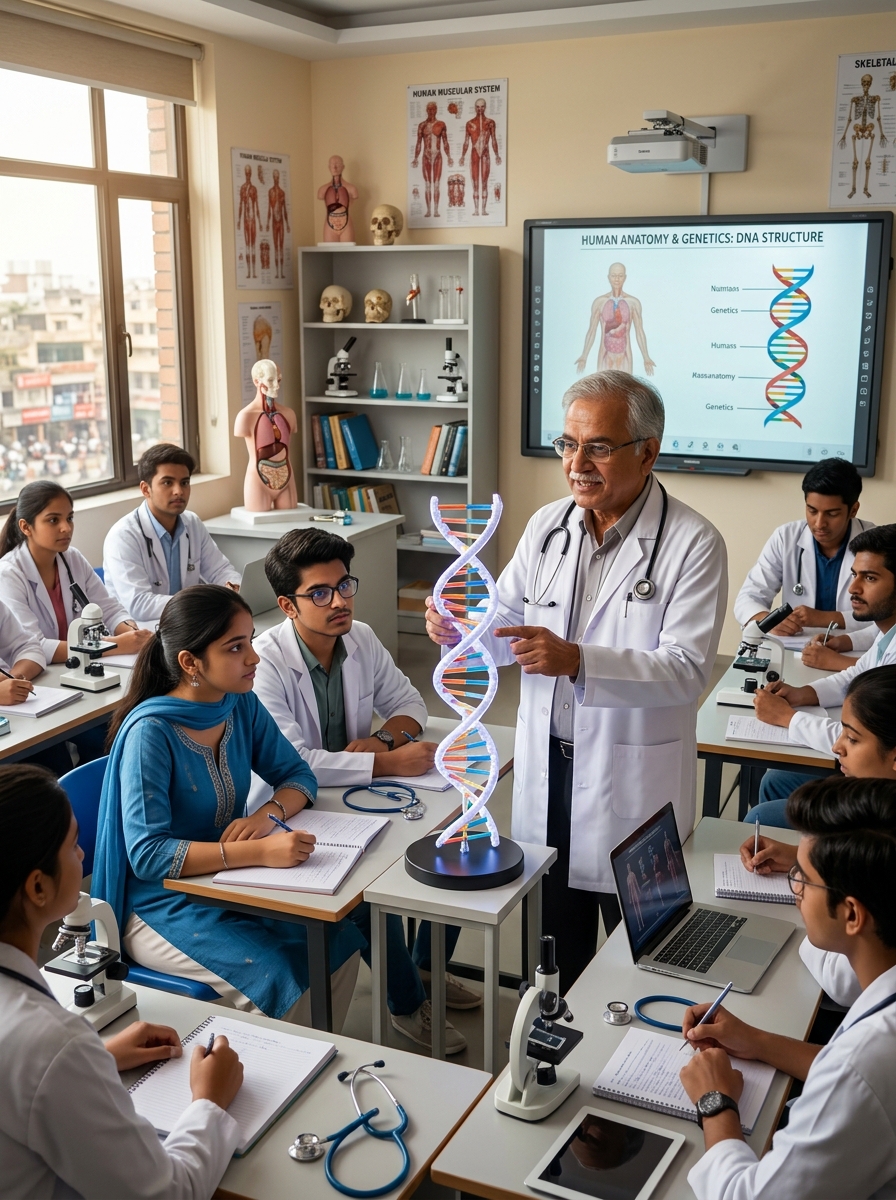
Crafting Tomorrow's Medical & Engineering Leaders.
NCERT-Centric Strategy
Line-by-line coverage of Biology, Physics, and Chemistry.
Doctor Mentorship
1-on-1 guidance and clinical doubt clearance from top medical faculty.
Our Medical Rankers & Hall of Excellence.
Our students who secured MBBS and BDS seats through NEET.

Syed Ahamed
NEET UG Top Ranker
"Secured a MBBS seat at AIIMS, New Delhi."

Nantha Gokul M
NEET UG Top Ranker
"Secured a MBBS seat at Madras Medical College."

Vainavika A
NEET UG Top Ranker
"Secured a MBBS seat at Govt. Medical College, Dindigul."

Nantha Kumar V
NEET UG Top Ranker
"Secured a MBBS seat at Govt. Medical College, Ariyalur."

Sethu
NEET UG Top Ranker
"Secured a BDS seat at Madras Medical College."

Trenifa
NEET UG Top Ranker
"Secured a MBBS seat at Govt. Ramanathapuram Medical College."

Sanjay
NEET UG Top Ranker
"Secured a MBBS seat at Govt. Medical College, Ariyalur."

Sripathy T L
NEET UG Top Ranker
"Secured a MBBS seat at Tirunelveli Medical College."
What Our Future Doctors Say
Hear directly from students who secured their MBBS & BDS seats.
"The faculty at Chennai branch is exceptional. Their guidance helped me clear Prelims."
Anjali Sharma
NEET Aspirant"The Mains Answer Writing program is a game changer. Highly recommended."
Karthik Raja
NEET Aspirant"Best IAS academy in Madurai. Very supportive environment."
Sneha Murali
NEET Aspirant"I am incredibly grateful to Pearls Academy for their exceptional guidance and support throughout my NEET preparation journey. The experienced faculty, comprehensive study materials, and regular practice tests helped me build a strong foundation and boosted my confidence. The personalized attention I received made a huge difference in my understanding of complex concepts. Thanks to Pearls Academy, I was well-prepared for the NEET exam and achieved the results I aimed for. I highly recommend Pearls Academy to anyone serious about their NEET preparation!"
Syed Ahamed
Batch 2023-24 · AIIMS, New Delhi"I am incredibly grateful to Pearls Academy for their excellent coaching and guidance throughout my NEET preparation journey. The faculty was not only knowledgeable but also supportive, always ready to clear my doubts and provide valuable insights. Their structured study plan, regular tests, and personalized feedback helped me stay focused and improve steadily. Thanks to Pearls Academy, I felt confident and well-prepared on exam day. I highly recommend this academy to any NEET aspirant!"
Nantha Gokul M
Batch 2023-24 · Madras Medical College"I am incredibly grateful to Pearls Academy for helping me prepare for the NEET exam. The experienced faculty, comprehensive study material, and regular mock tests made a significant difference in my understanding and performance. The personalized attention I received helped me clarify my doubts, and the interactive sessions made learning enjoyable. Pearls Academy truly provided the guidance and support I needed to excel in my NEET journey."
Vainavika A
Batch 2023-24 · Govt. Medical College, Dindigul"My journey with Pearls Academy has been nothing short of transformative. The NEET coaching provided me with a strong foundation, in-depth understanding, and confidence to tackle the exam. The experienced faculty, personalized attention, and comprehensive study materials made learning a breeze. Regular tests and feedback sessions helped me improve consistently. I am grateful to Pearls Academy for their unwavering support and guidance in helping me achieve my NEET goals."
Nantha Kumar V
Batch 2023-24 · Govt. Medical College, Ariyalur"I am immensely grateful to Pearls Academy for their exceptional NEET coaching. The faculty's dedication, personalized teaching methods, and comprehensive study materials helped me gain a deep understanding of each subject. Regular tests and doubt-clearing sessions boosted my confidence and prepared me well for the exam. Thanks to Pearls Academy, I felt fully equipped to tackle NEET and achieved my dream score."
Sethu
Batch 2023-24 · Madras Medical College"Pearls Academy provided the perfect environment for my NEET preparation. The teachers were always available to clear my doubts, and their guidance made complex topics much easier to understand. The study materials and regular mock tests helped me gain confidence and stay focused. Thanks to Pearls Academy, I feel well-prepared and optimistic about my future in the medical field."
Trenifa
Batch 2023-24 · Govt. Ramanathapuram Medical College"Joining Pearls Academy for NEET coaching was one of the best decisions I made. The faculty's guidance, comprehensive study materials, and regular mock tests helped me grasp complex topics and build confidence in my preparation. Their personalized attention and doubt-clearing sessions made a huge difference in my understanding of concepts. I'm grateful for the support and encouragement from Pearls Academy, which played a vital role in my NEET journey."
Sanjay
Batch 2023-24 · Govt. Medical College, Ariyalur"I joined Pearls Academy for my NEET preparation, and it has been a life-changing experience. The teachers are exceptionally knowledgeable, and their dedication to ensuring each student's success is unparalleled. The comprehensive study material, regular assessments, and doubt-clearing sessions helped me gain confidence and clarity in every topic. Thanks to Pearls Academy, I feel well-prepared and confident about achieving my dream of becoming a doctor. I highly recommend this academy to anyone aiming for success in NEET!"
Sripathy T L
Batch 2023-24 · Tirunelveli Medical CollegeOur Learning Centers Across Tamil Nadu.
Pearls Academy Main Campus
NEET Learning Center
Demo NEET Academy
NEET Learning Center